

Drilling is one of the most common machining operations in CNC manufacturing, but achieving accurate and consistent holes depends on much more than drill diameter and cutting speed. Drill geometry also plays an important role in drilling performance, and drill point angle is one of the key factors.
The point angle affects how a drill enters the workpiece, how cutting forces are distributed, how the material is removed, and how accurately the hole can be produced. Choosing an inappropriate point angle can lead to excessive thrust force, poor hole quality, tool wear, or even drill breakage.
Understanding drill point angle can therefore help manufacturers select the right drill geometry and improve CNC drilling efficiency and hole quality.
What Is Drill Point Angle?
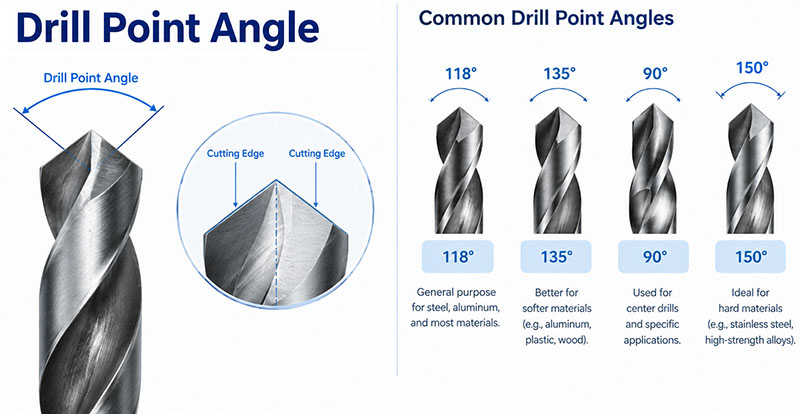
The drill point angle is the included angle formed by the two main cutting lips at the tip of a twist drill. It is measured across the drill point from one cutting edge to the other.
For example, a drill with a 118° point angle has an included angle of 118° between its two main cutting lips.
The point angle is different from the drill’s helix angle, which describes the angle of the helical flutes along the body of the drill. These two geometric features affect cutting performance in different ways.
The point angle primarily influences how the drill penetrates the workpiece and how the cutting forces are generated at the drill tip.
What Are the Most Common Drill Point Angles?
Several point angles are used in CNC drilling, but 118° and 135° are among the most common.
A 118° point angle is widely used for general-purpose drilling, particularly with conventional HSS twist drills. It provides a good balance between cutting ability, tool strength, and general-purpose performance.
A 135° point angle is commonly found on drills designed for harder materials and demanding machining conditions. Many 135° drills also use a split-point or similar point geometry, which improves centering and reduces the amount of material that must be displaced by the chisel edge.
However, point angle should not be considered independently. Drill material, coating, rake angle, relief angle, split-point geometry, workpiece material, hole depth, and machine rigidity can all affect the final drilling performance.
How Does Drill Point Angle Affect CNC Drilling?
1. It Affects Thrust Force
One of the most important effects of point angle is its influence on axial thrust force.
The drill point must push into the workpiece while the cutting lips remove material. The geometry of the point determines how the cutting load is distributed between the cutting lips and the central chisel edge.
A conventional 118° drill can provide effective penetration in many general-purpose applications. A larger point angle, such as 135°, is often used with optimized point geometry to improve cutting behavior and reduce the amount of force required to initiate the hole.
Lower thrust force can be particularly beneficial when drilling harder materials, thin components, or parts with limited structural rigidity.
It is important to note that the actual thrust force depends on more than point angle. Feed rate, drill diameter, material, drill geometry, and cutting conditions can have a significant effect as well.
2. It Affects Hole Location and Centering
The drill point is responsible for guiding the tool into the workpiece. If the drill tends to wander when it first contacts the surface, the resulting hole may not be located accurately.
A larger point angle is often combined with a split point or other self-centering geometry. This reduces the tendency of the drill to walk across the surface before the cutting edges fully engage.
For CNC machining, this can be especially useful when drilling holes on flat surfaces where positional accuracy is important.
However, machine positioning accuracy, workholding, tool runout, surface condition, and the use of a pilot hole or spot drill can also have a major influence on hole location.
3. It Influences Cutting Performance
Point angle changes the geometry of the cutting lips and the way they engage with the workpiece.
A smaller point angle generally produces a more pointed drill tip, while a larger point angle creates a flatter point. This changes the relationship between cutting edge length, penetration behavior, and the forces acting on the drill.
For general-purpose machining, a 118° point angle is often a practical choice because it provides balanced performance across a wide range of materials.
For demanding applications, however, a 135° point combined with an appropriate point design may provide better stability and cutting performance.
4. It Affects Drill Strength and Tool Life
The drill point also affects the mechanical strength of the cutting edges.
A very aggressive point geometry may provide good penetration but can reduce edge strength under certain conditions. A larger point angle can provide a stronger cutting-edge configuration, particularly when combined with suitable relief and split-point geometry.
Tool life is not determined by point angle alone. Excessive feed, incorrect cutting speed, poor chip evacuation, insufficient coolant, tool runout, and unsuitable coating can all cause premature drill wear.
For this reason, changing the point angle should normally be considered as part of the overall drill geometry rather than as an isolated adjustment.
118° vs. 135° Drill Point Angle
The difference between 118° and 135° is often discussed when selecting drills for CNC machining.
A 118° drill is a versatile general-purpose option. It is commonly used for mild steel, aluminum, plastics, wood, and many other relatively easy-to-machine materials, depending on the drill design and cutting conditions.
A 135° drill is often selected for harder or more difficult-to-machine materials. It is also commonly available with a split point, which helps the drill start more accurately and reduces walking.
However, it would be misleading to say that 135° is always better than 118°. The correct choice depends on the workpiece material, drill design, machine capability, hole diameter, depth, required accuracy, and cutting parameters.
How to Choose the Right Drill Point Angle
The best point angle should be selected according to the machining application rather than simply choosing the largest or smallest available angle.
Workpiece Material
Material hardness and machinability are important factors.
For general-purpose materials such as mild steel, a conventional 118° drill may provide reliable performance. Harder steels, stainless steels, and other difficult-to-machine materials may benefit from a 135° point or specialized point geometry.
Aluminum and other soft materials may require a drill specifically designed for high chip evacuation and appropriate rake geometry. In these applications, point angle is only one part of the tool-selection process.
Hole Diameter and Depth
Small-diameter drills are more sensitive to tool deflection and breakage, while deep holes require efficient chip evacuation and stable cutting conditions.
When drilling deep holes, manufacturers should consider drill geometry, flute design, coolant delivery, peck drilling strategy, and cutting parameters in addition to point angle.
Machine Rigidity
A rigid CNC machine and stable workholding system allow the drill to operate closer to its intended cutting conditions.
If the machine, fixture, or workpiece is not sufficiently rigid, excessive thrust or vibration can reduce hole quality regardless of the selected point angle
Required Hole Accuracy
When hole location and dimensional accuracy are critical, a spot drill, center drill, pilot hole, or specialized drill point may be used before the final drilling operation.
A suitable point geometry can improve the drill’s ability to start accurately, but it cannot compensate for excessive tool runout, poor workholding, or incorrect CNC programming.
Does Drill Point Angle Affect Hole Quality?
Yes. Drill point angle can influence several aspects of hole quality, including hole location, roundness, straightness, burr formation, and surface finish.
An unsuitable drill geometry may increase vibration or cutting forces, which can result in poor hole accuracy and surface quality.
However, hole quality is determined by the entire drilling system. Tool runout, spindle condition, machine rigidity, workholding, feed rate, cutting speed, coolant, drill wear, and material properties can all affect the final result.
For precision CNC machining, it is therefore better to treat drill point angle as one element of a complete drilling strategy.
Drill Point Angle and Burr Formation
Burrs are a common problem in CNC drilling, particularly when the drill breaks through the opposite side of a thin component.
Drill point geometry can influence the way material is removed as the tool approaches breakthrough. However, simply changing the point angle will not necessarily eliminate burrs.
Manufacturers may also control feed rate near breakthrough, use specialized drill geometries, add a backing plate, or perform a secondary deburring operation.
For thin sheets and precision components, the combination of drill geometry and breakthrough strategy is often more important than point angle alone.
Common Problems Caused by Incorrect Drill Selection
Selecting an unsuitable drill point angle or overall drill geometry can contribute to several machining problems.
Excessive thrust force may cause workpiece deformation or reduce tool life. Poor centering can result in hole-position errors. Vibration may produce poor surface finish and oversized or irregular holes. Inadequate chip evacuation can increase cutting temperature and accelerate tool wear.
In severe cases, the drill may seize inside the workpiece and break.
These problems are why professional CNC machining should consider the drill point, flute geometry, tool material, coating, cutting parameters, and machine conditions together.
Best Practices for CNC Drilling
For reliable CNC drilling performance, start by selecting a drill designed specifically for the workpiece material and application
Use a suitable point angle and point geometry rather than relying on diameter alone. Make sure the tool is properly clamped and check tool runout before machining. Maintain appropriate spindle speed and feed rate, and provide sufficient coolant or lubrication when required.
For deep holes, pay particular attention to chip evacuation. Depending on the material and hole depth, peck drilling or through-tool coolant may be necessary.
When positional accuracy is critical, consider using a spot drilling operation before the final hole. This can help the drill start more consistently and reduce the risk of wandering.
Finally, monitor tool wear. A drill that has become dull can produce more heat and cutting force even when all other machining parameters remain unchanged.
Conclusion
Drill point angle is a critical part of twist drill geometry and has a direct influence on CNC drilling performance. It affects how the drill enters the workpiece, how cutting forces are distributed, how accurately the tool starts, and how efficiently material is removed.
The commonly used 118° and 135° point angles each have their own advantages. A 118° drill is a versatile choice for many general-purpose applications, while a 135° point, particularly when combined with a split-point design, is often advantageous for demanding materials and applications where improved centering and cutting behavior are required.
Nevertheless, there is no single point angle that is ideal for every CNC drilling application. The right choice should take into account the workpiece material, drill diameter, hole depth, machine rigidity, required accuracy, drill material and coating, and cutting parameters.
For precision CNC machining, selecting the correct drill geometry is not simply a matter of choosing a point angle. It is about matching the entire tool design and machining process to the requirements of the part.