
Steel hardening processes play a critical role in improving the mechanical performance, wear resistance, and service life of precision-machined components. Depending on the material grade, component geometry, and operating conditions, different heat treatment methods can be used to achieve the required combination of surface hardness, core toughness, fatigue resistance, and dimensional stability.
Among the most widely used processes are quenching and tempering, carburizing, nitriding, and induction hardening. Although all four processes can improve the performance of steel components, they work through different metallurgical mechanisms and produce different hardness profiles.
For CNC machined parts, selecting the appropriate hardening process is particularly important because heat treatment can also affect dimensional accuracy, surface condition, machining sequence, and final inspection requirements.
This article explains how these four steel hardening processes work, compares their key characteristics, and discusses how to choose the right treatment for precision-engineered components.
Why Do Steel Parts Require Hardening?
Steel components used in industrial machinery, automation equipment, automotive systems, and precision tooling are often exposed to friction, impact, cyclic loading, and contact stress. In these conditions, untreated or insufficiently hardened steel may experience excessive wear, plastic deformation, surface fatigue, or premature failure.
Hardening processes modify the microstructure or surface composition of steel to improve its resistance to these operating conditions.
However, maximum hardness is not always the primary objective. A component that is extremely hard but insufficiently tough may become susceptible to cracking under impact or fluctuating loads. Similarly, a part that requires a hard wear-resistant surface may still need a relatively tough core to withstand bending and impact.
The correct heat treatment must therefore balance hardness, toughness, wear resistance, fatigue performance, and dimensional stability according to the component’s actual function.
1. Quenching and Tempering
Quenching and tempering is a widely used heat treatment process for improving the overall mechanical properties of steel. It is commonly applied to medium-carbon steels, alloy steels, shafts, gears, fasteners, machine components, and other parts requiring a combination of strength and toughness.
How Quenching and Tempering Work
Quenching generally involves heating steel to an appropriate austenitizing temperature, holding it for a specified period, and then cooling it rapidly using a suitable medium, such as oil, water, polymer solution, or gas.
The rapid cooling transforms the austenitic microstructure into martensite or a mixture of transformation products, depending on the steel grade and cooling conditions. Martensite is hard and strong, but it can also be brittle and contain significant residual stresses.
Tempering is performed after quenching. The steel is reheated to a temperature below its lower critical transformation temperature, held for a controlled period, and then cooled. This process reduces brittleness and residual stresses while improving toughness and dimensional stability.
The final properties depend on the steel composition, quenching conditions, tempering temperature, holding time, and component geometry.
Key Characteristics
Quenching and tempering can provide high strength throughout much or all of the component cross-section, depending on the steel’s hardenability and the size of the part.
Unlike surface hardening methods, this process is generally intended to improve the bulk mechanical properties of the material rather than selectively hardening only the surface.
It is suitable for components subjected to combined loads, including torsion, bending, and impact. However, rapid cooling can cause distortion or cracking, particularly in parts with complex geometries, sharp transitions, or uneven cross-sections.
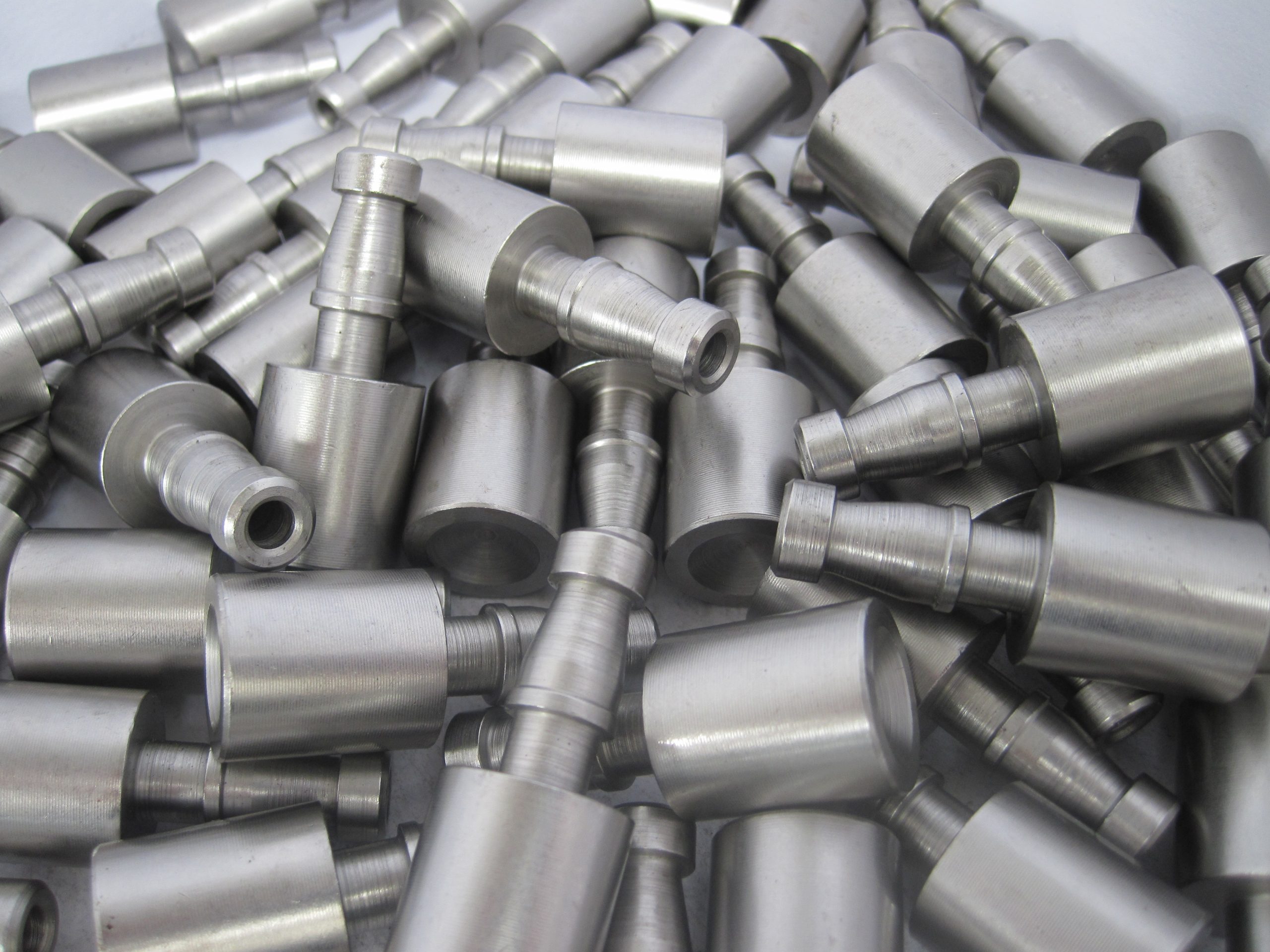
Typical Applications
Common applications include shafts, gears, pins, high-strength fasteners, couplings, machine-tool components, and structural mechanical parts.
For CNC machined components, quenching and tempering may be performed before final machining or grinding, depending on the required hardness, dimensional tolerances, and surface finish.
2. Carburizing
Carburizing is a thermochemical surface-hardening process primarily used for low-carbon steels and suitable low-carbon alloy steels. It increases the carbon concentration near the surface, allowing the treated layer to achieve high hardness after subsequent hardening.
This process is particularly useful for components that require a wear-resistant surface and a tougher, more ductile core.
How Carburizing Works
During carburizing, the steel component is heated to a temperature at which austenite is stable and exposed to a carbon-rich atmosphere or another controlled carbon source. Carbon diffuses into the surface, creating a carbon-enriched layer.
After carburizing, the component is generally quenched to develop a hard martensitic case. Tempering may then be used to adjust the final properties and reduce brittleness.
The resulting hardened layer is known as the case, while the underlying material is referred to as the core.
Case depth depends on factors such as temperature, treatment duration, steel composition, and the subsequent hardening process. The required case depth should be selected according to the contact stress, wear conditions, and load-bearing requirements of the component.
Key Characteristics
Carburizing can produce a high-hardness surface with good wear resistance while preserving a comparatively tough core.
It is commonly used for parts subjected to repeated contact, rolling or sliding loads, and demanding surface-fatigue conditions.
One important consideration is dimensional distortion. Carburizing typically involves high processing temperatures followed by quenching, which can change dimensions and geometry. Precision components may therefore require grinding or other finishing operations after heat treatment
Typical Applications
Carburizing is widely used for transmission gears, pinions, shafts, sprockets, bearings-related components, and other mechanical parts requiring a hard case and a tough core.
For precision CNC parts, the specified case depth and hardness should be defined according to the functional requirements rather than selected solely to maximize surface hardness.
3. Nitriding
Nitriding is a thermochemical surface-hardening process that introduces nitrogen into the surface of suitable steels. The nitrogen reacts with alloying elements or forms iron nitrides, depending on the steel composition and treatment conditions, creating a hard surface layer.
Nitriding is particularly valuable when high surface hardness, wear resistance, and relatively low heat-treatment distortion are required.
How Nitriding Works
In gas nitriding, the component is exposed to a controlled nitrogen-bearing atmosphere, commonly based on ammonia, at an appropriate temperature. Plasma nitriding uses an ionized gas environment to facilitate nitrogen introduction into the surface. Other nitriding methods are also available.
Nitrogen diffuses into the steel and forms a hardened diffusion zone. Depending on the process conditions, a compound layer may also develop at the surface.
Unlike conventional carburizing, nitriding is generally performed at temperatures below the lower critical transformation temperature of the steel. Because it does not normally require a subsequent quench, it can produce less distortion than quench-based hardening methods.
However, nitriding is not suitable for every steel grade. The alloy composition, initial microstructure, prior heat treatment, and required nitrided-layer properties must be considered carefully.
Key Characteristics
Nitriding can provide high surface hardness, improved wear resistance, and enhanced resistance to certain forms of surface fatigue. It is particularly useful for components requiring dimensional stability after treatment.
The hardened layer is generally relatively shallow compared with some carburized cases, although the actual depth depends on the steel, process, temperature, and duration.
The compound layer formed during nitriding can be beneficial in some applications but undesirable in others. Its thickness, porosity, and mechanical integrity may need to be controlled according to the service conditions.
Typical Applications
Common applications include precision shafts, spindles, molds, dies, extrusion components, hydraulic components, and machine parts exposed to friction or repeated surface loading.
For CNC machined components with tight tolerances, nitriding may reduce the amount of post-treatment correction required. Nevertheless, dimensional changes can still occur, so critical dimensions should be verified after treatment.
4. Induction Hardening
Induction hardening is a localized surface-hardening process that uses electromagnetic induction to heat selected areas of a steel component rapidly. The heated region is then quenched to form a hard martensitic surface layer.
Unlike carburizing and nitriding, induction hardening does not depend on introducing carbon or nitrogen into the steel. Instead, it changes the microstructure of the existing steel through localized heating and rapid cooling.
How Induction Hardening Works
An alternating electrical current passes through an induction coil, generating an electromagnetic field that induces currents in the steel component. These currents heat the surface or a selected region to the required transformation temperature.
The heated area is then rapidly quenched using an appropriate cooling medium. The result is a hardened surface layer, while the interior generally retains more of its original microstructure and toughness.
The depth and distribution of the hardened zone depend on the steel grade, electrical frequency, power, heating time, coil design, component geometry, and quenching conditions.
Induction hardening is particularly suitable for components that require selective hardening of specific functional surfaces rather than the entire part.
Key Characteristics
Induction hardening can provide high surface hardness, good wear resistance, and efficient processing for suitable production volumes. Because heating is localized, it can limit the thermal exposure of areas that do not require hardening.
However, the steel must contain sufficient carbon to achieve the desired martensitic hardness. The process is therefore commonly used with medium-carbon steels and suitable alloy steels.
Uneven heating, improper coil design, or inadequate quenching can result in inconsistent hardness depth, distortion, or cracking. The transition between hardened and unhardened regions must also be considered during component design.
Typical Applications
Typical applications include shafts, gear teeth, bearing journals, guide rails, axles, pins, and other components with localized wear surfaces.
For CNC machined parts, induction hardening can be effective when only selected surfaces require high hardness while the remaining structure needs to retain greater toughness.
Comparing the Four Steel Hardening Processes
The main difference between these processes is how they improve the material’s properties and where the resulting hardness is concentrated.
Quenching and tempering primarily improve the bulk mechanical properties of steel. They are suitable when a component requires a balanced combination of strength and toughness throughout its section.
Carburizing increases the carbon concentration near the surface and usually combines this enrichment with quenching. It is an effective choice for low-carbon steel components requiring a hard, wear-resistant case and a tough core.
Nitriding introduces nitrogen into the surface to create a hardened layer, usually without a subsequent quench. It is often preferred when surface hardness and dimensional stability are important, provided the steel grade is suitable.
Induction hardening locally heats and quenches selected regions of a steel component. It is useful when particular surfaces require high hardness but the rest of the part does not need the same treatment.
No single process is universally superior. The correct choice depends on the steel grade, required hardness, hardened-layer depth, contact conditions, fatigue requirements, component geometry, production volume, and allowable dimensional change.
How to Choose the Right Hardening Process for CNC Machined Parts
Selecting a heat treatment process should begin with the functional requirements of the component.
Consider the Steel Grade
The chemical composition determines which hardening mechanisms are available and how effectively they can be applied.
Low-carbon steels are commonly used for carburizing because carbon enrichment creates a hardenable surface. Nitriding requires a suitable steel and prior microstructure to achieve the desired case properties. Induction hardening generally requires sufficient carbon in the existing steel to develop the target surface hardness.
Quenching and tempering is available for a wide range of carbon and alloy steels, but the required hardenability must be considered for thicker sections.
Define the Required Hardness and Case Depth
Surface hardness alone does not fully describe the performance of a hardened component. The required hardness profile and effective case depth may be equally important.
The appropriate requirements should be based on loading conditions, wear mechanisms, and service life expectations.
Evaluate Dimensional Tolerances and Distortion Risk
Heat treatment can change the dimensions of CNC machined parts through thermal expansion, phase transformation, residual stress redistribution, and other metallurgical effects.
Quenching-based processes, particularly carburizing followed by quenching, can create significant distortion depending on the component geometry and treatment conditions. Induction hardening can also cause localized dimensional changes. Nitriding often produces relatively low distortion, but it does not eliminate dimensional variation.
For tight-tolerance components, manufacturers should plan the machining sequence around the expected heat-treatment effects. This may involve leaving grinding allowance, machining critical features after treatment, or using suitable fixturing and process controls.
Consider Production Volume and Cost
The most appropriate process also depends on production quantity, equipment availability, processing time, and inspection requirements.
Induction hardening may be cost-effective for repeated production of components with defined localized hardening zones, although coil design and setup costs must be considered.
Carburizing can be efficient for batches of gears and other components requiring a hardened case. Nitriding may involve longer treatment cycles but can reduce the need for dimensional correction in suitable applications.
Quenching and tempering remains a versatile option for parts requiring improved overall strength and toughness.
The total manufacturing cost should include heat treatment, handling, possible post-treatment machining or grinding, inspection, and the risk of rejected parts.
CNC Machining Before and After Heat Treatment
The sequence of CNC machining and heat treatment has a direct effect on final accuracy and manufacturing cost.
For many components, rough machining is performed before heat treatment to remove most of the material efficiently. A finishing allowance may be retained on critical surfaces to accommodate distortion or dimensional changes.
After treatment, grinding or precision machining may be required to achieve the final dimensions, geometric tolerances, and surface finish. The amount of finishing depends on the hardening process, steel grade, component geometry, and required accuracy.
For nitrided parts, final dimensions and surface requirements should be established with the nitriding process in mind because removing too much material afterward can reduce or eliminate the effective hardened layer.
For induction-hardened parts, the machining plan must account for the location and depth of the hardened region. Subsequent material removal should not compromise the specified hardness profile.
Clear communication between the CNC machining supplier and the heat-treatment provider is essential. Material specifications, hardness requirements, case depth, treatment standards, and post-treatment inspection criteria should be defined before production begins.
Quality Inspection After Steel Hardening
Heat-treated components should be inspected according to their functional and engineering requirements.
Hardness testing verifies whether the material or treated surface meets the specified hardness range. Depending on the part and specification, Rockwell, Vickers, or other suitable methods may be used. Surface hardness and core hardness should not be treated as interchangeable measurements.
For carburized, nitrided, or induction-hardened parts, case depth or hardened-layer depth may also require verification. The applicable definition and test method should be specified because different standards distinguish between total and effective case depth.
Dimensional inspection is equally important. Micrometers, gauges, optical measurement systems, and coordinate measuring machines can be used to verify critical dimensions and geometric tolerances.
For components exposed to cyclic loading or high contact stress, additional inspection may be required to detect cracks or other defects. Suitable non-destructive testing methods depend on the material, geometry, specification, and application.
A comprehensive inspection plan helps ensure that the component meets not only the hardness requirement but also its dimensional, geometric, and functional requirements.
Conclusion
Quenching and tempering, carburizing, nitriding, and induction hardening are four important processes for improving the performance of steel components. Each offers different advantages in terms of bulk strength, surface hardness, wear resistance, case depth, and dimensional stability.
Quenching and tempering is primarily used to improve overall strength and toughness. Carburizing creates a carbon-enriched, hardened case for demanding wear and contact applications. Nitriding provides a hard nitrogen-enriched surface with relatively low distortion in suitable steels. Induction hardening selectively hardens specific regions through localized heating and quenching.
For precision CNC machined parts, the best process is the one that meets the component’s actual service requirements while maintaining acceptable dimensional accuracy, manufacturing cost, and inspection capability.
By considering material composition, loading conditions, required hardness, case depth, geometry, and machining sequence together, manufacturers can select a suitable hardening process and produce steel components with reliable performance and a longer service life.