


Tungsten is widely known for its exceptional strength, extremely high melting point, and outstanding wear resistance. It is commonly used in aerospace, tooling, electronics, and high-performance industrial applications. However, one question that often arises—especially in engineering and manufacturing—is:
Is tungsten magnetic?
From a material science and machining perspective, understanding tungsten’s magnetic behavior is important for selecting the right material in sensitive environments and ensuring compatibility with specific applications.
Is Tungsten Magnetic?
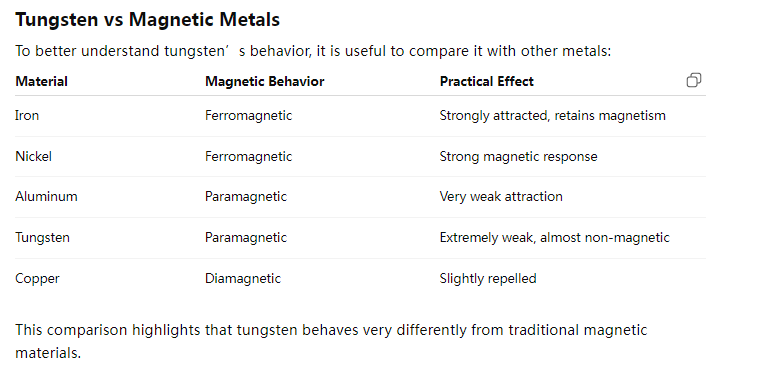
In its pure form, tungsten is not magnetic in the conventional sense. Unlike ferromagnetic metals such as iron, nickel, or cobalt, tungsten does not exhibit strong attraction to magnets and cannot retain magnetism.
However, tungsten is classified as a paramagnetic material, meaning it shows only a very weak attraction to a magnetic field. This effect is extremely small and typically undetectable without specialized equipment.
In practical terms, this means:
- A standard magnet will not attract pure tungsten
- Tungsten does not become permanently magnetized
- Any magnetic response is negligible in most applications
Why Tungsten Is Not Strongly Magnetic
The magnetic behavior of a material is determined by its atomic structure and electron configuration.
Tungsten has unpaired electrons in its outer shell, which gives it weak paramagnetic properties. However, unlike ferromagnetic materials, these electrons do not align in a way that produces strong, lasting magnetism.
Instead, tungsten may slightly respond to a magnetic field, but once the external field is removed, the effect disappears immediately.
This is why tungsten is often considered a non-magnetic engineering material in real-world applications.
Why Some Tungsten Products Appear Magnetic
In industrial environments, many people notice that certain tungsten products seem to respond to magnets. This can be confusing, but the explanation lies in material composition.
Most commercial tungsten materials are not pure tungsten. Instead, they are:
- Tungsten alloys (with nickel, iron, or copper)
- Tungsten carbide (often bonded with cobalt or other metals)
These added elements can introduce magnetic behavior. For example:
- Cobalt and iron are strongly magnetic
- Nickel contributes to magnetic response in alloys
As a result, the magnetism observed in tungsten components usually comes from binder metals or alloying elements—not tungsten itself.
Key Physical Properties of Tungsten
Beyond magnetism, tungsten is valued for several outstanding properties:
- Extremely high melting point (over 3400°C)
- Very high density (~19.3 g/cm³)
- Excellent wear resistance (especially as tungsten carbide)
- High strength at elevated temperatures
These characteristics make tungsten one of the most important materials in high-performance engineering applications.
Why Tungsten’s “Non-Magnetic” Nature Matters
Even though tungsten is technically paramagnetic, it is widely treated as a non-magnetic material in engineering practice. This property is highly valuable in several scenarios:
- Precision Measurement and Inspection
In environments where magnetic interference must be minimized—such as coordinate measuring systems or sensitive instruments—non-magnetic materials are preferred.
- Medical and Imaging Applications
Tungsten components are often used in medical environments where magnetic fields (such as MRI systems) are present. Low magnetic interaction reduces interference and improves safety.
- Aerospace and Defense
In aerospace systems, materials with minimal magnetic signatures are important for reducing interference with navigation and detection systems.
- Electronics and High-Frequency Systems
Non-magnetic materials help maintain signal integrity and prevent electromagnetic disturbances.
Machining Considerations for Tungsten
From a CNC machining perspective, tungsten presents significant challenges despite its favorable physical properties.
- High hardness leads to rapid tool wear
- Brittleness increases the risk of cracking
- High density increases cutting resistance
For tungsten carbide, the situation becomes even more complex due to its extreme hardness.
Machining tungsten typically requires:
- Specialized cutting tools (carbide or diamond)
- Controlled cutting parameters
- Advanced cooling strategies
- Precision grinding or EDM processes
Understanding its material behavior—including its non-magnetic nature—helps engineers select appropriate machining and inspection methods.
Tungsten vs Magnetic Metals
To better understand tungsten’s behavior, it is useful to compare it with other metals:
Conclusion
Tungsten is not magnetic in the way most people expect. While it exhibits weak paramagnetic behavior, it is effectively considered a non-magnetic material in practical engineering and manufacturing applications.
Any noticeable magnetism in tungsten products is typically caused by alloying elements such as cobalt, nickel, or iron—not tungsten itself.
For engineers and manufacturers, understanding tungsten’s magnetic properties is essential when selecting materials for precision, medical, aerospace, or electronic applications. Combined with its exceptional strength and heat resistance, tungsten remains a critical material for high-performance environments.