


Material hardness is one of the most important mechanical properties in manufacturing and engineering. It directly influences a material’s resistance to wear, deformation, scratching, and indentation. Whether selecting materials for CNC machining, evaluating heat treatment results, or performing quality control inspections, hardness testing plays a critical role in determining the suitability of a material for a specific application.
Because different materials exhibit different mechanical behaviors, various hardness testing methods have been developed over time. Each testing method uses its own measurement principle, test procedure, and hardness scale. Understanding these methods and their corresponding units is essential for engineers, machinists, and quality control professionals.
What Is Material Hardness?
Hardness refers to a material’s ability to resist localized plastic deformation when subjected to external force. In practical terms, hardness indicates how well a material can withstand scratching, indentation, abrasion, or penetration by another object.
Although hardness is often associated with material strength, the two properties are not identical. Hardness primarily measures surface resistance to deformation, while strength describes the material’s ability to withstand applied loads without failure.
In manufacturing, hardness testing is commonly used to:
- Verify material specifications
- Evaluate heat treatment effectiveness
- Assess wear resistance
- Perform quality control inspections
- Compare different materials
- Predict machining behavior
Hardness testing is widely applied to metals, plastics, ceramics, coatings, and composite materials.
Why Hardness Testing Matters
Material hardness affects numerous aspects of manufacturing and product performance.
For example, a hardened steel gear requires sufficient hardness to resist wear during operation, while a cutting tool must possess significantly higher hardness than the workpiece material it machines. Similarly, aerospace and automotive components often require specific hardness ranges to balance durability and toughness.
Hardness testing helps manufacturers ensure that materials meet design requirements and industry standards before parts enter service.
Common Hardness Testing Methods
Several hardness testing methods are used throughout industry. Each method is designed for specific material types, thicknesses, and testing requirements.
Brinell Hardness Test
The Brinell hardness test is one of the oldest and most widely recognized hardness testing methods.
In this test, a hardened steel or tungsten carbide ball is pressed into the material surface under a specified load. After the load is removed, the diameter of the indentation is measured and used to calculate the hardness value.
Brinell testing is particularly suitable for:
- Cast iron
- Forgings
- Aluminum alloys
- Large metal components
- Materials with coarse grain structures
Because the indentation is relatively large, Brinell testing provides an average hardness value over a broader surface area.
The hardness result is expressed using the Brinell Hardness Number (HB or HBW).
Rockwell Hardness Test
The Rockwell test is one of the most commonly used hardness testing methods in manufacturing because it is fast, simple, and requires minimal sample preparation.
Unlike Brinell testing, Rockwell hardness is determined by measuring the depth of penetration under a specified load.
Different Rockwell scales are available depending on the material being tested. Common scales include:
- Rockwell C (HRC) for hardened steels
- Rockwell B (HRB) for softer metals
- Rockwell A (HRA) for hard materials and thin coatings
The Rockwell method is widely used for:
- Heat-treated steels
- Tool steels
- Stainless steels
- Industrial components
- Quality control inspections
Because testing is rapid and relatively nondestructive, Rockwell hardness testing is commonly performed directly on production parts.
Vickers Hardness Test
The Vickers hardness test uses a diamond pyramid indenter to create a small square-shaped indentation on the material surface.
After applying the test load, the lengths of the indentation diagonals are measured microscopically, and the hardness value is calculated.
One major advantage of Vickers testing is its versatility. The same indenter can be used for both soft and hard materials by simply adjusting the applied load.
Vickers testing is commonly used for:
- Thin materials
- Surface coatings
- Microstructure analysis
- Precision components
- Research applications
Results are reported as HV (Vickers Hardness).
The Vickers method is known for its high accuracy and excellent repeatability.
Knoop Hardness Test
The Knoop hardness test is a microhardness testing method designed for very thin materials and fragile specimens.
Instead of using a symmetrical pyramid, Knoop testing employs an elongated diamond indenter that produces a shallow indentation.
This makes it particularly suitable for:
- Thin coatings
- Ceramics
- Glass materials
- Surface treatments
- Small precision components
Because of its minimal penetration depth, Knoop testing allows hardness evaluation without significantly damaging the specimen.
Results are expressed as HK (Knoop Hardness).
Shore Hardness Test
While Brinell, Rockwell, and Vickers testing are primarily used for metals, Shore hardness testing is commonly applied to plastics, rubbers, elastomers, and soft polymers.
The Shore test measures the resistance of a material to indentation using a spring-loaded indenter.
Several Shore scales exist, including:
- Shore A for soft rubbers and elastomers
- Shore D for harder plastics and rigid polymers
The Shore method is widely used in industries producing seals, gaskets, flexible components, and plastic products.
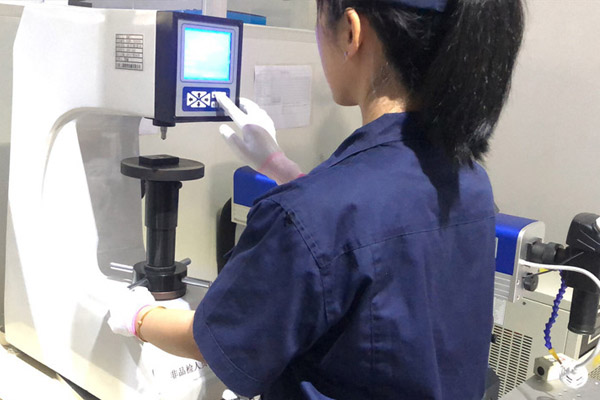
Microhardness Testing
Microhardness testing refers to hardness measurements performed under very small loads.
Both Vickers and Knoop methods can be adapted for microhardness applications.
Microhardness testing is often used for:
- Thin coatings
- Surface treatments
- Weld zones
- Small components
- Material research
This testing method allows engineers to analyze hardness variations within specific microstructural regions of a material.
Understanding Hardness Units
One of the most common sources of confusion in hardness testing is the variety of hardness units used throughout industry.
Unlike measurements such as length or weight, hardness values are not universal. Each testing method uses its own scale and unit.
Brinell Hardness (HB or HBW)
Brinell hardness values are expressed as HB or HBW.
Examples include:
- Aluminum alloy: 60–120 HBW
- Mild steel: 120–180 HBW
- Hardened steel: 300–650 HBW
- Rockwell Hardness (HR)
Rockwell values depend on the testing scale.
Examples include:
- HRB 60–100 for softer metals
- HRC 20–70 for hardened steels
Tool steels often fall within the range of HRC 55–65 after heat treatment.
Vickers Hardness (HV)
Vickers hardness values can cover an extremely wide range.
Examples include:
- Annealed steel: 120–200 HV
- Hardened steel: 500–900 HV
- Ceramic materials: over 1000 HV
Knoop Hardness (HK)
Knoop hardness values are primarily used for coatings, ceramics, and microhardness testing applications.
Factors Affecting Hardness Test Results
Several variables can influence hardness measurements.
Material composition plays a major role, as alloying elements often increase hardness and wear resistance. Heat treatment processes such as quenching, tempering, and case hardening can also significantly alter hardness values.
Surface condition is another important factor. Rough surfaces, contamination, oxidation, or residual stresses may affect test accuracy.
Additionally, specimen thickness must be sufficient to prevent substrate effects from influencing indentation measurements.
Proper sample preparation and adherence to testing standards are essential for obtaining reliable results.
Hardness Testing in Manufacturing
Hardness testing is an essential part of modern manufacturing quality control.
Manufacturers routinely perform hardness inspections to verify:
- Raw material quality
- Heat treatment effectiveness
- Surface coating performance
- Wear resistance characteristics
- Compliance with engineering specifications
In CNC machining, hardness data helps determine cutting tool selection, machining parameters, and expected tool life.
For aerospace, automotive, medical, and industrial applications, hardness testing provides critical information that helps ensure component reliability and long-term performance.
Conclusion
Material hardness is a fundamental property that directly affects wear resistance, durability, machinability, and overall product performance. Because different materials and applications require different evaluation methods, several hardness testing systems have been developed, including Brinell, Rockwell, Vickers, Knoop, and Shore testing.
Understanding the principles, units, and applications of these hardness measurement methods allows engineers and manufacturers to make informed decisions about material selection, heat treatment, quality control, and manufacturing processes.
As modern manufacturing continues to demand higher precision and performance, hardness testing will remain one of the most important tools for evaluating and ensuring material quality across a wide range of industries.