


Heat treatment plays a critical role in determining the mechanical properties and performance of steel components. Among the various heat treatment processes used in manufacturing, annealing and normalizing are two of the most common methods for improving material characteristics before machining, fabrication, or final service.
Although both processes involve heating steel above its critical temperature and then cooling it, they produce significantly different microstructures and mechanical properties. Choosing the correct process can greatly affect hardness, strength, ductility, machinability, and overall component performance.
Understanding the differences between annealing and normalizing helps engineers and manufacturers select the most appropriate treatment for specific applications.
What Is Annealing?
Annealing is a heat treatment process designed to soften steel, relieve internal stresses, improve ductility, and enhance machinability.
During annealing, the steel is heated to a temperature above its critical transformation point and held at that temperature for a specified period. After sufficient soaking time, the material is cooled very slowly, usually inside the furnace.
The slow cooling rate allows the steel’s microstructure to transform gradually, producing a relatively coarse grain structure and a softer material condition.
Annealing is commonly performed after casting, forging, welding, or extensive machining operations to eliminate residual stresses and restore material workability.
The primary objectives of annealing include:
- Reducing hardness
- Improving ductility
- Relieving internal stress
- Enhancing machinability
- Refining microstructure
- Improving dimensional stability
Because annealed steel becomes softer, it is often easier to machine, form, bend, or further process during manufacturing.
What Is Normalizing?
Normalizing is another heat treatment process used to improve the structure and mechanical properties of steel. Like annealing, the material is heated above its critical temperature and held long enough for complete transformation.
However, the major difference lies in the cooling method.
Instead of cooling slowly inside the furnace, normalized steel is removed from the furnace and allowed to cool naturally in still air.
The faster cooling rate results in a finer grain structure compared with annealed steel. This finer microstructure typically produces higher strength and hardness while maintaining reasonable ductility.
Normalizing is frequently used to create a more uniform grain structure and improve the consistency of mechanical properties throughout the material.
The primary purposes of normalizing include:
- Increasing strength
- Improving toughness
- Refining grain size
- Enhancing structural uniformity
- Eliminating non-uniform microstructures
- Preparing steel for further heat treatment
Because normalized steel possesses a better balance between strength and ductility, it is often selected for structural and load-bearing applications.
How Annealing and Normalizing Differ
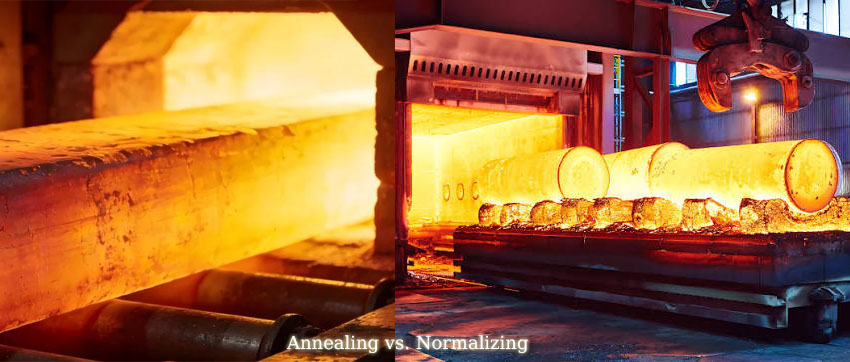
At first glance, annealing and normalizing appear very similar because both involve heating steel above the transformation temperature. However, the cooling process creates substantial differences in the final material properties.
Annealed steel cools slowly within the furnace, allowing coarse pearlite and larger grain structures to develop. This results in a softer material with lower strength but greater ductility and improved machinability.
Normalized steel cools more rapidly in air, producing finer pearlite and smaller grain sizes. The refined microstructure increases hardness and tensile strength while maintaining good toughness.
As a result, normalized steel is generally stronger than annealed steel, while annealed steel is generally easier to machine and form.
The choice between the two processes depends largely on the desired balance between strength and workability.
Microstructure Differences
The microstructure produced during heat treatment directly influences material performance.
In annealing, slow cooling allows carbon atoms more time to diffuse throughout the steel. This produces relatively coarse pearlite and larger ferrite grains.
The coarse microstructure reduces hardness and improves ductility, making the material more suitable for forming and machining operations.
Normalizing, by contrast, cools the material at a faster rate. The shorter transformation time produces finer pearlite and a more refined grain structure.
Fine-grained steel generally exhibits:
- Higher strength
- Improved toughness
- Better fatigue resistance
- More uniform mechanical properties
This microstructural refinement is one of the primary reasons why normalizing is widely used in structural engineering applications.
Mechanical Property Comparison
The differences in cooling rates lead to noticeable variations in mechanical properties.
Annealed steel typically exhibits lower hardness and lower tensile strength. However, it offers superior ductility and reduced internal stress, making it ideal for subsequent manufacturing operations.
Normalized steel generally provides higher hardness and greater tensile strength due to its refined grain structure. While its ductility is slightly lower than that of annealed steel, it still maintains sufficient toughness for many engineering applications.
In practical manufacturing environments, annealing is often chosen when maximum machinability or formability is required, whereas normalizing is preferred when improved strength and structural integrity are desired.
Effects on Machinability
Machinability is an important consideration in CNC machining and precision manufacturing.
Annealed steel is often easier to machine because its lower hardness reduces cutting forces and tool wear. The softer microstructure allows cutting tools to remove material more efficiently, resulting in smoother machining operations.
For this reason, many steel components are annealed before extensive machining processes begin.
Normalized steel can still be machined effectively, but its increased hardness may require more robust cutting tools and optimized machining parameters. Tool wear may occur more rapidly compared with annealed material.
Nevertheless, normalized steel often provides a better balance between machining performance and final mechanical properties.
Applications of Annealed Steel
Annealed steel is commonly used when manufacturing processes require significant forming, shaping, or machining.
Typical applications include:
- CNC machined components
- Cold-formed parts
- Deep-drawn products
- Forged components
- Welded assemblies
- Precision machined tools
The reduced hardness and improved ductility make annealed steel easier to process and less susceptible to cracking during fabrication.
In many manufacturing environments, annealing serves as an intermediate process before final heat treatment.
Applications of Normalized Steel
Normalized steel is frequently selected for applications requiring improved mechanical performance without the complexity of more advanced heat treatment processes.
Common applications include:
- Structural steel components
- Shafts and gears
- Heavy machinery parts
- Automotive components
- Construction equipment
- Pressure vessel components
The improved strength and uniformity achieved through normalizing make it particularly valuable for parts subjected to dynamic loads and mechanical stress.
Cost Considerations
From a production perspective, normalizing is often more economical than annealing.
Because annealing requires slow furnace cooling, the process consumes more time and occupies furnace capacity for longer periods. This increases energy consumption and production costs.
Normalizing allows the material to cool in ambient air, reducing furnace usage and shortening processing time.
As a result, manufacturers often choose normalizing when the required material properties can be achieved without the additional cost associated with full annealing.
Which Process Should You Choose?
Selecting between annealing and normalizing depends on the intended application and performance requirements.
If the primary goal is maximum machinability, ductility, stress relief, or formability, annealing is usually the preferred choice.
If higher strength, improved toughness, and a refined grain structure are more important, normalizing often provides a better solution.
In many manufacturing workflows, steel may undergo both processes at different stages depending on production requirements.
Engineers should consider factors such as material grade, component geometry, machining requirements, and final service conditions when determining the most appropriate heat treatment method.
Conclusion
Annealing and normalizing are two fundamental heat treatment processes used throughout the steel manufacturing industry. While both involve heating steel above its critical temperature, the cooling method creates significant differences in microstructure and mechanical performance.
Annealing produces a softer, more ductile material with excellent machinability and reduced internal stress, making it ideal for forming and machining operations. Normalizing creates a finer grain structure with improved strength, toughness, and structural uniformity, making it well suited for load-bearing and engineering applications.
Understanding the distinctions between these processes enables manufacturers to optimize material performance, improve production efficiency, and ensure that steel components meet the demands of their intended applications.