

When selecting engineering plastics for CNC machining, Delrin and Nylon are two commonly considered materials. Both offer good mechanical properties, wear resistance, and relatively easy machinability, but their behavior during machining and their performance in finished parts can be quite different.
For CNC machined components, material selection affects not only strength and durability but also dimensional accuracy, surface finish, machining stability, and long-term performance. Understanding the differences between Delrin and Nylon can help engineers choose the right material for a specific application.
This article compares Delrin vs Nylon for CNC machining, focusing on machinability, dimensional tolerance, moisture absorption, mechanical performance, surface finish, and typical applications.
What Is Delrin?
Delrin is a commercial name commonly associated with acetal homopolymer (POM-H), a type of engineering thermoplastic known for its low friction, good dimensional stability, stiffness, and wear resistance.
Delrin is widely used for precision CNC machined parts because it can be machined efficiently and generally produces clean edges and good surface finishes.
Its relatively low moisture absorption is another important advantage. Compared with Nylon, Delrin tends to maintain its dimensions more consistently when environmental humidity changes.
Common CNC machined Delrin components include gears, bushings, rollers, bearings, spacers, guides, fixtures, and other precision mechanical parts.
What Is Nylon?
Nylon is a family of engineering thermoplastics that includes materials such as PA6 and PA66. Nylon is valued for its toughness, impact resistance, wear resistance, and good mechanical strength.
Unlike Delrin, Nylon can absorb a noticeable amount of moisture from the surrounding environment. This moisture absorption can change its dimensions and mechanical properties, which is an important consideration when manufacturing tight-tolerance CNC components.
Nylon is commonly used for gears, bushings, rollers, wear components, structural parts, cable guides, and applications where toughness and impact resistance are important.
Because Nylon is available in many grades and reinforced formulations, its properties can vary significantly depending on the specific grade.
Delrin vs Nylon: Machinability
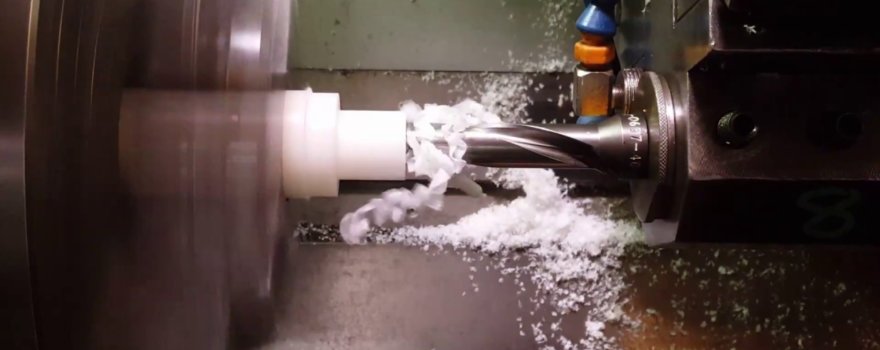
Both Delrin and Nylon can be CNC machined using standard milling and turning processes, but they behave differently during machining.
Delrin is generally considered easier to machine when tight dimensional control and a clean surface finish are required. Its relatively stable material structure allows CNC machining operations to produce precise features with predictable results.
Delrin also tends to produce relatively manageable chips when the cutting tool, spindle speed, and feed rate are properly selected.
Nylon is also machinable, but its flexibility and toughness can make it more sensitive to machining conditions. Excessive cutting pressure may cause the material to deform instead of being cleanly cut. Heat generated during machining can also affect dimensional stability.
For this reason, sharp cutting tools, appropriate cutting parameters, and good chip evacuation are particularly important when machining Nylon.
Which Material Holds Tighter CNC Tolerances?
For many precision machining applications, Delrin has an advantage in dimensional stability.
Its low moisture absorption means that dimensions are less affected by changes in humidity. This makes Delrin particularly suitable for components requiring consistent fits, clearances, or relatively tight tolerances.
Nylon requires more attention to environmental conditions. Because it absorbs moisture, a Nylon component may change dimensions after machining as its moisture content changes.
This does not mean that Nylon cannot be used for precision CNC parts. High-quality Nylon components can be machined accurately, but engineers need to consider the material grade, moisture condition, environmental exposure, and required tolerance when defining the machining process.
For critical applications, the dimensional condition of the material should be considered before machining rather than treating the nominal material dimensions as completely stable.
Moisture Absorption and Dimensional Stability
Moisture absorption is one of the most important differences between Delrin and Nylon.
Delrin has relatively low water absorption, so its dimensions and mechanical properties remain comparatively stable in humid environments.
Nylon, on the other hand, is hygroscopic. It absorbs moisture from the atmosphere, and the amount of absorbed moisture can affect both its dimensions and mechanical properties.
For CNC machining, this can become particularly important when producing:
- Tight-fitting components
- Bushings and bearing surfaces
- Precision gears
- Mating components
- Components used in humid environments
If a Nylon part is machined in a dry condition and later absorbs moisture, its dimensions may change. Therefore, the expected service environment should be considered when establishing machining tolerances.
Strength, Stiffness, and Toughness
Delrin and Nylon have different mechanical characteristics, so the stronger material depends on the specific application and material grade.
Delrin offers good stiffness, dimensional stability, fatigue resistance, and low friction. It is often a good choice when a component needs to maintain its shape and dimensions under repeated mechanical movement.
Nylon is known for its toughness and impact resistance. It can absorb mechanical shocks and withstand certain demanding loading conditions without becoming as brittle as some other plastics.
However, Nylon’s mechanical properties are strongly influenced by moisture content. A dry Nylon component can behave differently from one that has absorbed moisture during service.
Therefore, comparing only the nominal tensile strength of Delrin and Nylon does not provide enough information for material selection.
Wear and Friction Performance
Both Delrin and Nylon offer good wear resistance, making them useful for moving mechanical components.
Delrin is particularly attractive for applications requiring low friction, good sliding behavior, and dimensional stability. It is frequently used for gears, bushings, rollers, and other components where repeated movement occurs.
Nylon also provides good wear resistance and toughness. It can perform well in applications involving impact, sliding, and repeated mechanical loading.
The actual wear performance depends on factors such as load, speed, surface roughness, lubrication, temperature, mating material, and the specific grade of plastic.
For demanding wear applications, engineers should therefore evaluate the complete operating conditions rather than selecting a material based only on a general wear-resistance ranking.
Surface Finish After CNC Machining
Delrin generally produces a clean and consistent machined surface when appropriate tooling and cutting parameters are used.
Its relatively rigid structure makes it suitable for precision milling and turning, and finished surfaces can have a smooth appearance without extensive secondary finishing.
Nylon can also achieve good surface finishes, but its lower stiffness and greater tendency to deform under cutting forces can make machining more sensitive.
If the cutting tool is dull or the cutting parameters generate excessive heat, Nylon may show surface defects, dimensional variation, or other machining problems.
For both materials, sharp tools and appropriate feeds and speeds are essential for achieving a consistent surface finish.
Delrin vs Nylon for Different CNC Machined Parts
The best material depends heavily on the function of the component.
Delrin is often a good choice for precision gears, bushings, bearings, rollers, guides, and low-friction components where dimensional stability and smooth movement are important.
Nylon may be preferable for components requiring toughness, impact resistance, or greater flexibility. It is commonly used for mechanical parts that may experience shock loads or demanding operating conditions.
For example, a precision bushing operating with tight clearance may benefit from Delrin’s dimensional stability, while a component exposed to repeated impact may benefit from Nylon’s toughness.
The final decision should always consider the actual load, temperature, environment, friction, wear, and dimensional requirements.
Delrin vs Nylon: Key Factors to Consider
When choosing between the two materials, engineers should consider more than the basic material datasheet.
Dimensional requirements are critical. If the component requires tight tolerances and stable dimensions over time, Delrin may have an advantage.
Environmental conditions are equally important. Exposure to humidity can have a much greater effect on Nylon than on Delrin.
Mechanical loading should also be evaluated. If impact resistance and toughness are more important than dimensional stability, Nylon may be the better option.
Machining requirements should be considered as well. Part geometry, wall thickness, hole size, tolerance, surface finish, and production volume can all affect the appropriate CNC machining strategy.
Finally, the exact material grade matters. Different Nylon grades and different acetal formulations can have significantly different properties, so the material specification on the engineering drawing should be clearly defined.
Tips for CNC Machining Delrin and Nylon
Although both materials are relatively easy to machine, several practices can help improve machining quality.
Use sharp cutting tools designed for plastics and avoid excessive cutting pressure. Maintain suitable cutting speeds and feed rates to prevent unnecessary heat generation.
For Nylon, pay particular attention to workholding. Excessive clamping force can deform the part and cause dimensional errors after the component is released.
For thin-walled Delrin or Nylon components, machining strategy is also important. Removing material gradually and maintaining balanced cutting forces can reduce deformation.
When tight tolerances are required, allow the part to reach a stable temperature before final inspection. For Nylon components, environmental humidity and material conditioning should also be considered.
Conclusion
Delrin and Nylon are both excellent materials for CNC machined plastic components, but they offer different advantages.
Delrin is particularly well suited to precision applications where dimensional stability, low moisture absorption, low friction, wear resistance, and consistent machining performance are important.
Nylon is often preferred when toughness, impact resistance, flexibility, and mechanical durability are the primary requirements.
For CNC machining, the key difference is not simply which material is stronger or easier to machine. The more important question is whether the material can maintain the required dimensions, mechanical performance, and surface quality throughout machining and actual service conditions.
By considering material grade, part geometry, machining tolerances, environmental exposure, operating loads, and production requirements together, manufacturers can make a more reliable choice between Delrin and Nylon for CNC machined parts.