

Low-volume CNC machining presents a unique challenge for manufacturers. Unlike mass production, where high production volumes can justify expensive dedicated tooling and automated fixtures, low-volume jobs often involve frequent part changes, different geometries, and shorter production runs.
However, low production volume does not mean that accuracy and efficiency are less important. Prototype parts, engineering samples, replacement components, and small batches often require tight tolerances and consistent quality.
In these situations, custom CNC fixtures can provide an effective way to improve workholding stability, machining accuracy, setup efficiency, and overall production reliability without the cost and complexity of highly specialized production tooling.
What Is a Custom CNC Fixture?
A CNC fixture is a workholding device used to position and secure a workpiece during machining. A custom fixture is specifically designed around the geometry, dimensions, and machining requirements of a particular part or group of similar parts.
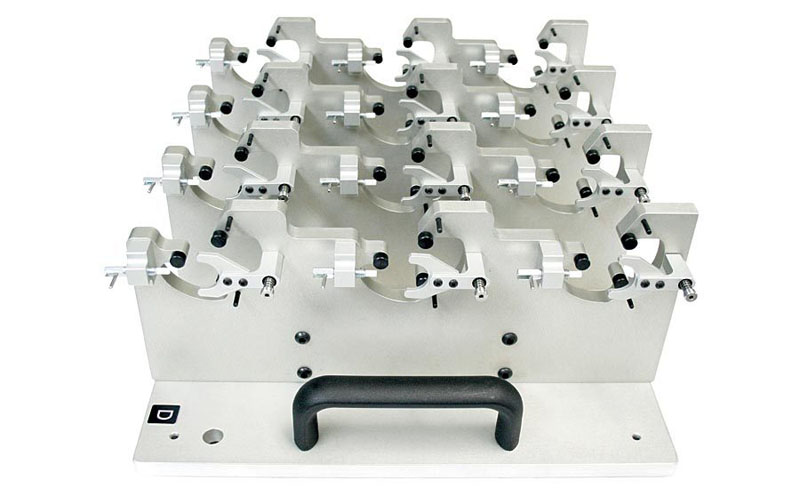
Unlike a standard vise or universal clamping system, a custom fixture can incorporate dedicated locating surfaces, pins, pockets, clamps, stops, and other features that match the workpiece.
The main purpose is not simply to hold the part in place. A well-designed fixture establishes a repeatable relationship between the workpiece and the machine coordinate system, allowing the CNC machine to perform machining operations more consistently.
For low-volume production, fixtures can often be simpler than those used for mass production. The goal is to achieve the required accuracy and efficiency without unnecessary tooling costs.
Why Workholding Matters in Low-Volume CNC Machining
Workholding has a direct impact on machining accuracy.
If a workpiece moves, rotates, or deforms during cutting, even a highly accurate CNC machine cannot produce the intended geometry reliably. Poor workholding can lead to dimensional variation, vibration, tool deflection, surface-quality problems, and inconsistent part positioning.
This becomes particularly challenging in low-volume machining because different jobs may require different setups. When operators repeatedly reposition a part manually, there is a greater possibility of positioning errors.
A custom fixture reduces this variability by providing defined locating and clamping points. Once the fixture is properly set up, each workpiece can be positioned in a more consistent manner.
How Custom Fixtures Improve CNC Machining Accuracy
Repeatable Part Positioning
One of the biggest advantages of a custom fixture is repeatability.
A fixture can use precision locating pins, reference surfaces, pockets, or stops to establish the position of the workpiece. Instead of relying entirely on manual alignment, the operator can place the part against predetermined locating features.
This helps reduce variation between setups and makes it easier to maintain consistent part positioning throughout a small production run.
For parts with multiple machining operations, repeatable positioning is particularly valuable because the relationship between different features must remain consistent.
Better Stability During Cutting
Cutting forces can cause a poorly supported workpiece to move or vibrate.
A properly designed fixture supports the workpiece at appropriate locations and applies clamping force without unnecessarily deforming the part. This creates a more stable machining environment.
Improved stability can help reduce vibration and tool deflection, which contributes to better dimensional accuracy and surface finish.
This is especially important when machining thin walls, deep pockets, irregular geometries, or relatively flexible components.
Improved Datum Control
CNC machining relies heavily on accurate datums and work coordinates.
A custom fixture can be designed around the part’s functional datums, making it easier to establish a consistent relationship between the workpiece and the CNC coordinate system.
Instead of locating the part based only on convenient external surfaces, the fixture can reference the surfaces that are most important to the final component.
This approach can reduce accumulated positioning errors and improve the relationship between critical features.
How Custom Fixtures Improve Efficiency
Accuracy is only part of the equation. In low-volume CNC machining, reducing setup and handling time can also have a significant impact on production cost.
Reduced Setup Time
Without a suitable fixture, an operator may need to manually align each workpiece, adjust clamps, find reference points, and verify the setup before machining.
A custom fixture can simplify many of these steps.
Once the fixture is installed and aligned, the operator can position the workpiece using predefined locating features. This reduces repetitive setup work and allows machining to begin more quickly.
The time savings can be particularly valuable when producing small batches where setup time represents a relatively large portion of total production time.
Faster Part Loading and Unloading
Fixture design can also influence how quickly parts can be loaded and removed.
For low-volume production, a fixture does not necessarily need a complex automated clamping system. Even simple features such as accessible clamps, locating pins, stops, and clearance areas can make loading and unloading much easier.
A fixture that allows the operator to quickly place the part in the correct position can improve production efficiency without requiring expensive automation.
Fewer Manual Adjustments
Manual positioning and repeated measurement can consume considerable time.
With a well-designed custom fixture, the operator does not need to independently establish the position of every workpiece. The fixture provides a physical reference system that guides the part into the intended position.
This reduces the number of manual adjustments and can make the machining process more consistent from one part to the next.
Custom Fixtures for Complex Part Geometries
Standard workholding solutions are not always suitable for irregularly shaped components.
Parts with curved surfaces, thin sections, angled features, or complex external profiles may have limited areas available for conventional clamping.
A custom fixture can be designed around the actual geometry of the component. Support points can be placed where they provide adequate stability while avoiding interference with the cutting tool.
This allows more of the part to remain accessible for machining and can reduce the need for repeated repositioning.
For multi-sided components, a fixture can also be designed to provide controlled access to several machining areas within the same setup.
Custom Fixtures for Multi-Operation Machining
Many CNC machined components require multiple operations.
A typical part may need milling, drilling, tapping, pocketing, contouring, and other features to be machined from different orientations.
If the part is manually repositioned between operations, each additional setup introduces another opportunity for positioning error.
A custom fixture can help combine multiple operations into fewer setups where the part geometry and machine configuration allow it.
Reducing the number of setups can improve both efficiency and positional accuracy, particularly when several features must maintain tight relationships with one another.
Custom Fixtures vs. Standard Workholding
Standard vises, clamps, soft jaws, and modular workholding systems are highly useful for many CNC machining jobs. They are flexible and often provide the most economical solution for one-off or very simple parts.
However, custom fixtures become more attractive when the part has complex geometry, tight positional requirements, repeated machining operations, or a small batch size that justifies faster setup and loading.
The choice does not have to be either completely standard or completely custom. In many low-volume applications, manufacturers can combine standard workholding components with custom fixture plates, soft jaws, locating pins, or supports.
This approach can provide much of the benefit of dedicated tooling while keeping fixture costs under control.
How to Design a Custom Fixture for Low-Volume Production
Fixture design should begin with the machining requirements rather than simply the external shape of the part.
The first consideration is the datum structure. The fixture should locate the workpiece from surfaces that provide a reliable reference for the critical dimensions and features.
The second consideration is clamping force. The fixture must hold the workpiece securely against cutting forces while avoiding excessive pressure that could deform the component.
The third consideration is tool access. Locating pins and clamps should not interfere with the cutter, drill, spindle, or other machining operations.
Another important factor is chip evacuation. Fixture features should be arranged so that chips do not accumulate around critical locating surfaces or prevent the workpiece from seating correctly.
Finally, the fixture should be easy for the operator to use. A technically accurate fixture that takes too long to load or requires complicated adjustments may not provide a practical advantage in low-volume production.
Custom Fixtures and Overall Production Cost
The value of a custom fixture should not be measured only by its purchase or manufacturing cost.
A more useful calculation considers the total effect on the machining process, including:
Fixture Cost + Setup Time + Loading Time + Inspection + Scrap + Rework
A relatively inexpensive standard setup may require significant manual adjustment for every part. In contrast, a custom fixture may have a higher initial cost but reduce setup and handling time throughout the production run.
For low-volume manufacturing, this can make custom workholding economically practical even when the total production quantity is relatively small.
Conclusion
Custom fixtures can provide significant advantages in low-volume CNC machining, particularly when accuracy, repeatability, and setup efficiency are important.
By providing consistent locating references and stable workholding, a custom fixture can help improve dimensional accuracy and reduce positioning variation. At the same time, faster loading, fewer manual adjustments, and reduced setup time can make small-batch production more efficient.
The most effective fixture does not necessarily need to be complicated or highly automated. For many low-volume CNC applications, a carefully designed fixture plate, soft jaw, locating system, or dedicated support can provide the right balance between cost, accuracy, flexibility, and production efficiency.
When designing custom machined parts for low-volume production, fixture requirements should be considered early in the manufacturing process. A good workholding strategy can make the difference between a setup that is slow and difficult to repeat and a machining process that is stable, efficient, and consistent.