


High-Density Polyethylene (HDPE) is one of the most widely used engineering plastics due to its excellent chemical resistance, low moisture absorption, impact strength, and lightweight characteristics. From industrial tanks and piping systems to food processing equipment and precision-machined plastic components, HDPE provides a reliable alternative to metals and other engineering plastics in many applications.
Although HDPE is relatively easy to machine compared with many harder materials, its unique properties require careful consideration during CNC machining. Factors such as thermal expansion, material flexibility, chip control, and tool selection directly affect machining accuracy and surface quality.
This article explores the key properties and advantages of HDPE, along with practical CNC machining tips for producing high-quality HDPE components.
What Is High-Density Polyethylene (HDPE)?
High-Density Polyethylene is a thermoplastic polymer made from ethylene molecules. Compared with other polyethylene grades, HDPE has a higher molecular density and a more tightly packed molecular structure, giving it improved strength, rigidity, and chemical resistance.
HDPE is commonly produced through polymerization processes that create long molecular chains with fewer branches. This structure allows the material to achieve better mechanical performance while maintaining the lightweight and flexible characteristics typical of polyethylene.
Unlike thermosetting plastics, HDPE can be heated, reshaped, and recycled multiple times without significant chemical degradation. This makes it a popular material choice for both industrial and consumer applications.
Key Properties of HDPE
Excellent Chemical Resistance
One of HDPE’s most important advantages is its outstanding resistance to chemicals. The material performs well when exposed to acids, alkalis, solvents, detergents, and many industrial chemicals.
This chemical stability makes HDPE suitable for applications involving aggressive environments, including chemical storage tanks, laboratory equipment, and fluid handling systems.
Unlike some metals that may corrode when exposed to chemicals, HDPE maintains its structural integrity without requiring additional protective coatings.
High Impact Strength
HDPE offers excellent impact resistance, even at relatively low temperatures. Its ability to absorb mechanical shocks without cracking makes it suitable for demanding industrial environments.
Components made from HDPE can withstand repeated impacts and vibration, which is why the material is frequently used in protective covers, machine components, transportation equipment, and wear-resistant parts.
Low Moisture Absorption
HDPE absorbs very little water compared with many other plastics. This property allows machined HDPE components to maintain stable performance in wet environments.
Low moisture absorption also helps reduce dimensional changes caused by humidity, making HDPE suitable for applications involving water treatment, marine equipment, and food processing machinery.
Low Friction and Wear Resistance
The naturally low coefficient of friction of HDPE allows it to operate smoothly against other surfaces without requiring additional lubrication.
This characteristic makes HDPE an excellent choice for wear strips, bearings, guide rails, bushings, and sliding components. In many applications, HDPE can reduce maintenance requirements and extend equipment service life.
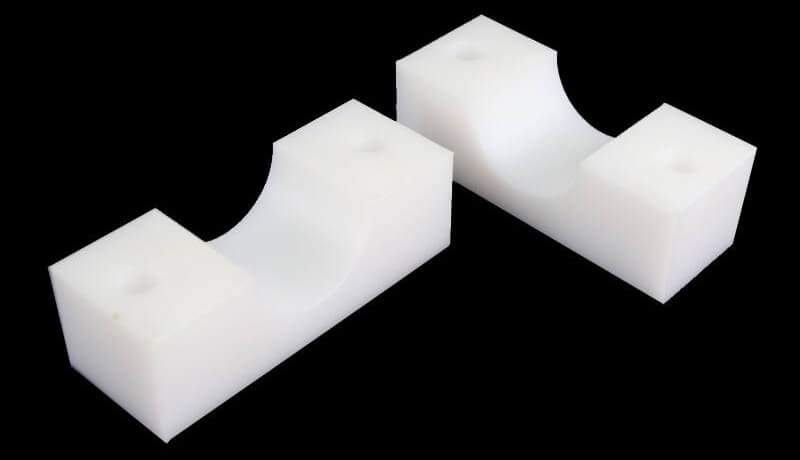
Lightweight Structure
HDPE has a much lower density than metals such as aluminum or steel. This lightweight property helps reduce overall product weight while maintaining sufficient mechanical strength for many applications.
Industries such as transportation, packaging, and material handling often choose HDPE when weight reduction is an important design consideration.
Advantages of HDPE for CNC Machining
HDPE is considered a highly machinable plastic because it cuts easily and places relatively low demands on cutting tools.
Compared with metals, HDPE generates lower cutting forces, which allows manufacturers to achieve efficient machining speeds while extending tool life. Standard CNC milling and turning equipment can process HDPE without requiring specialized machinery.
Another advantage is its ability to produce complex geometries. CNC machining allows manufacturers to create custom HDPE components with precise dimensions, internal features, grooves, holes, and complex contours without the need for expensive molds.
This makes CNC-machined HDPE particularly valuable for prototypes, low-volume production, and customized industrial parts.
HDPE also provides excellent surface quality after machining. When the correct cutting parameters and tooling are used, manufacturers can achieve smooth finishes without extensive secondary processing.
Common CNC Machining Applications of HDPE
HDPE CNC machining is widely used across multiple industries.
In the food processing industry, HDPE components are valued because they are chemically resistant, easy to clean, and suitable for environments requiring strict hygiene standards. Common applications include cutting boards, guides, machine guards, and conveyor components.
The chemical processing industry uses HDPE for tanks, pump components, valve parts, and protective liners because of its resistance to corrosive substances.
In the automotive and transportation sectors, HDPE is used for lightweight covers, fuel system components, bushings, and wear-resistant parts.
Medical and laboratory industries also benefit from HDPE components due to their chemical resistance and low moisture absorption. Typical applications include equipment housings, trays, and custom fixtures.
CNC Machining Tips for HDPE
Although HDPE is easy to machine, manufacturers must control several factors to achieve accurate and consistent results.
Select the Right Cutting Tools
Tool selection directly affects surface quality and dimensional accuracy when machining HDPE.
Sharp cutting tools are essential because they produce clean cuts and prevent excessive material deformation. Carbide tools are commonly used because they maintain edge sharpness and provide longer service life compared with standard steel tools.
Tools with polished cutting edges are especially beneficial because they reduce friction and prevent melted plastic from sticking to the cutting edge.
Control Cutting Speed and Feed Rate
HDPE has a relatively low melting point compared with metals, so excessive heat generation can cause surface defects.
Using appropriate spindle speeds and feed rates helps maintain stable cutting temperatures. If the cutting speed is too high or the feed rate is too low, friction may increase and cause the material to soften, melt, or develop poor surface quality.
A balanced cutting strategy allows the tool to remove material efficiently while preventing heat buildup.
Consider Thermal Expansion
One of the biggest challenges when machining HDPE is its relatively high coefficient of thermal expansion.
Unlike metals, HDPE can expand and contract significantly with temperature changes. Heat generated during machining may temporarily affect dimensions, causing measurement differences between the machined part and the final application environment.
Manufacturers should allow sufficient cooling time before performing critical measurements. For precision components, machining conditions and inspection procedures should account for potential thermal effects.
Use Proper Workholding Methods
HDPE is softer and more flexible than metals, which means excessive clamping force can deform the workpiece.
Rigid fixtures should provide adequate support without compressing the material. Vacuum tables, soft jaws, and customized fixtures are often used to prevent distortion during machining.
Proper workholding becomes especially important when producing thin walls or large HDPE components.
Manage Chips Effectively
HDPE typically produces long, continuous chips during CNC machining. Poor chip management can affect surface quality and interrupt the machining process.
Using appropriate tool geometry, optimized feed rates, and effective chip evacuation methods helps maintain stable production. Air cooling is often preferred because it removes chips without introducing unnecessary moisture or thermal shock.
Surface Finishing Options for HDPE
HDPE generally achieves a smooth surface directly after CNC machining, but additional finishing may be required for specific applications.
Sanding and polishing can improve appearance and remove minor machining marks. However, excessive heat during finishing should be avoided because it may soften the surface.
For applications requiring improved appearance or reduced friction, manufacturers may apply specialized finishing techniques depending on the functional requirements.
In many industrial applications, the natural machined finish of HDPE is already sufficient because the material’s performance characteristics are more important than cosmetic appearance.
Design Considerations for CNC Machined HDPE Parts
Designing HDPE components with manufacturing in mind helps improve quality and reduce costs.
Engineers should consider the material’s flexibility and thermal expansion when defining tolerances. Extremely tight tolerances that are common in metal machining may not always be practical for HDPE components.
Sharp internal corners should be minimized because CNC tools naturally produce rounded corners. Adding appropriate corner radii improves manufacturability and reduces machining time.
Thin walls and unsupported features should also be carefully evaluated because HDPE can flex during machining. Increasing wall thickness or adding support features can improve dimensional stability.
Conclusion
High-Density Polyethylene is a versatile engineering plastic that combines chemical resistance, impact strength, low friction, lightweight performance, and excellent machinability. These characteristics make HDPE an ideal choice for a wide range of industrial applications, from chemical equipment and food processing machinery to custom precision components.
CNC machining allows manufacturers to produce high-quality HDPE parts with complex geometries and reliable dimensional accuracy. However, achieving the best results requires careful control of cutting tools, machining parameters, workholding methods, and thermal effects.
By understanding HDPE’s unique material behavior and applying proper machining strategies, manufacturers can produce durable, cost-effective components that meet demanding performance requirements across diverse industries.