


Hardened tool steel is widely used to manufacture molds, dies, punches, cutting tools, and other wear-resistant components that must withstand extreme mechanical stress. After heat treatment, these materials offer exceptional hardness, dimensional stability, and long service life. However, the same properties that make hardened tool steel ideal for demanding applications also make it extremely difficult to machine using conventional cutting methods.
Traditional CNC milling and turning often face challenges such as rapid tool wear, high cutting forces, thermal distortion, and limited geometric flexibility when machining hardened materials. To overcome these limitations, many manufacturers rely on Wire Electrical Discharge Machining (Wire EDM). Because the process removes material through controlled electrical discharges rather than mechanical cutting, it delivers exceptional precision while eliminating many of the problems associated with conventional machining.
This article explains why Wire EDM has become the preferred manufacturing process for hardened tool steel and explores its advantages, applications, and key design considerations.
Why Hardened Tool Steel Is Difficult to Machine
Tool steels are commonly heat treated to hardness levels between 50 and 65 HRC, depending on the material grade and application. At these hardness levels, the material offers excellent wear resistance but becomes significantly more difficult to machine.
Conventional cutting tools experience much higher cutting forces when machining hardened steel. Tool edges wear rapidly, cutting temperatures increase, and vibration becomes more difficult to control. These factors can reduce dimensional accuracy and shorten tool life, particularly when producing intricate features or tight internal corners.
Complex geometries create additional challenges. Deep slots, narrow cavities, and sharp internal profiles often require extremely small cutting tools, which are more susceptible to breakage when machining hardened materials.
As component complexity increases, manufacturers often find that traditional machining becomes less economical and less capable of meeting strict dimensional requirements.
What Is Wire EDM?
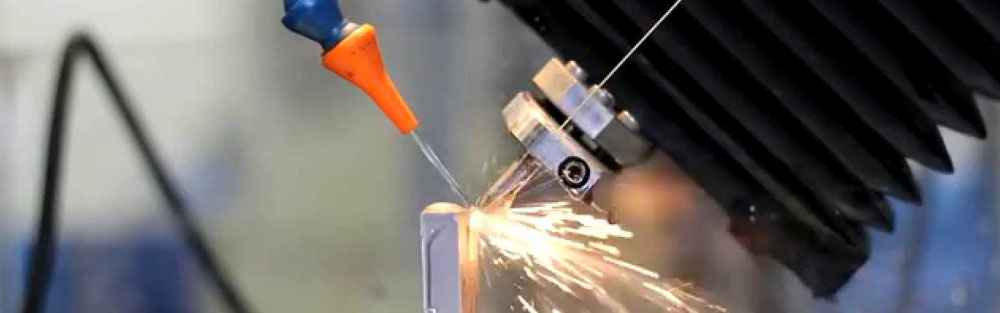
Wire EDM is a non-contact machining process that removes electrically conductive material using a continuously moving metal wire and a series of precisely controlled electrical sparks.
Instead of physically cutting the workpiece, the wire generates localized electrical discharges that melt and vaporize microscopic amounts of material. A dielectric fluid continuously cools the cutting zone while flushing away eroded particles.
Because the wire never touches the workpiece, the process produces virtually no mechanical cutting force. This unique characteristic allows Wire EDM to machine extremely hard materials without causing tool pressure, distortion, or chatter.
The process is suitable for any electrically conductive material, regardless of hardness, making it particularly valuable for hardened tool steels.
Why Wire EDM Is Ideal for Hardened Tool Steel?
Wire EDM offers several advantages that make it the preferred process for machining hardened tool steel components.
One of its greatest strengths is that material hardness has little influence on machining capability. Whether the workpiece measures 30 HRC or 62 HRC, Wire EDM removes material through electrical erosion rather than mechanical cutting. This allows manufacturers to perform final machining after heat treatment without sacrificing accuracy.
The absence of cutting forces also eliminates many problems associated with conventional machining. Thin walls, delicate features, and slender sections remain stable throughout the machining process because the workpiece is not subjected to mechanical stress.
Wire EDM also enables manufacturers to produce highly complex geometries that would be difficult or impossible to achieve using traditional milling operations. Intricate contours, narrow slots, fine internal radii, and precision profiles can all be machined with exceptional consistency.
Exceptional Dimensional Accuracy
Many industries choose Wire EDM because of its outstanding precision.
Modern Wire EDM equipment routinely achieves dimensional tolerances within a few microns while maintaining excellent repeatability throughout production. The process is particularly effective for manufacturing precision dies, stamping tools, injection mold inserts, and aerospace components that require extremely tight tolerances.
Because the wire diameter remains highly consistent throughout machining, complex profiles maintain excellent dimensional stability even during long cutting cycles.
Manufacturers can also produce sharp internal corners that would otherwise require extremely small milling cutters, reducing both tooling costs and machining risk.
Superior Surface Finish
Surface quality is another major advantage of Wire EDM.
The process creates smooth, uniform surfaces with minimal mechanical damage because there is no direct contact between the cutting tool and the workpiece. Multiple skim-cut operations further improve surface finish by removing a very small amount of material during each pass.
For many precision tooling applications, the resulting surface quality reduces or even eliminates the need for secondary grinding or polishing operations. This shortens production time while maintaining excellent dimensional accuracy.
The combination of high precision and superior surface finish makes Wire EDM particularly valuable for components with demanding functional or sealing surfaces.
Reduced Tool Wear and Lower Manufacturing Risk
Traditional machining of hardened tool steel often requires premium carbide or cubic boron nitride (CBN) cutting tools, which can be expensive and subject to rapid wear.
Wire EDM uses a continuously fed wire electrode that is automatically replaced during machining. As a result, tool wear does not significantly affect dimensional accuracy in the same way it does during conventional cutting.
The non-contact process also greatly reduces the risk of part deformation, tool breakage, or sudden machining failure. This makes Wire EDM especially attractive for expensive tooling components where scrapping a finished workpiece would result in significant financial loss.
Typical Applications of Wire EDM
Wire EDM has become a standard manufacturing process across many precision industries.
Tool and die manufacturers rely on Wire EDM to produce blanking dies, progressive dies, punches, and forming tools with extremely accurate cutting profiles.
Injection mold manufacturers use the process to machine hardened mold inserts, sliders, lifters, ejector components, and precision cavities after heat treatment.
The aerospace industry applies Wire EDM to produce turbine components, precision fixtures, and structural parts requiring tight dimensional control.
Medical device manufacturers use the technology to machine miniature surgical instruments, orthopedic tooling, and precision implant manufacturing equipment.
Electronics manufacturers also benefit from Wire EDM when producing connector tooling, semiconductor molds, and precision conductive components.
Design Considerations for Wire EDM
Although Wire EDM offers outstanding precision, thoughtful design can further improve manufacturing efficiency.
Designers should consider the wire diameter when specifying internal corner radii. Since the wire cannot produce a perfectly sharp internal corner, the minimum radius depends on the selected wire size.
Parts requiring Wire EDM must also be electrically conductive. Materials such as hardened tool steel, stainless steel, carbide, titanium, and copper alloys are suitable, while most plastics and ceramics cannot be machined using this process.
Proper start-hole placement is another important consideration. Internal features generally require a pre-drilled hole through which the wire can be threaded before cutting begins.
Finally, designers should avoid specifying unnecessarily tight tolerances unless they are functionally required. While Wire EDM is capable of extremely high accuracy, tighter tolerances typically increase machining time and production cost.
Wire EDM vs. Conventional CNC Machining
Both Wire EDM and CNC machining play important roles in manufacturing, but each process offers distinct advantages.
CNC milling and turning generally provide faster material removal for large volumes of stock and are well suited for producing external features, pockets, and simple geometries before heat treatment.
Wire EDM excels during the final manufacturing stage when components have already been hardened. It consistently delivers higher accuracy, superior surface finish, and greater geometric flexibility while eliminating cutting forces that could compromise delicate features.
Many manufacturers combine both processes. They perform rough machining using conventional CNC equipment before heat treatment, then complete the final precision features using Wire EDM. This hybrid approach maximizes both productivity and machining accuracy.
Conclusion
Hardened tool steel presents significant machining challenges due to its high hardness, excellent wear resistance, and demanding dimensional requirements. While conventional CNC machining remains valuable for rough machining operations, Wire EDM has become the precision standard for finishing hardened components.
Its non-contact machining process eliminates cutting forces, minimizes tool wear, and delivers exceptional dimensional accuracy on even the most complex geometries. Combined with excellent surface quality and the ability to machine fully hardened materials, Wire EDM provides manufacturers with a reliable solution for producing precision tooling, molds, dies, aerospace components, and medical devices.
As industries continue to demand tighter tolerances and more sophisticated tooling, Wire EDM will remain one of the most important technologies for machining hardened tool steel with unmatched precision and consistency.