

Surface grinding is an essential finishing process in precision manufacturing, particularly when tight dimensional tolerances, flatness, parallelism, and surface finish are required. Among the various grinding methods used in machine shops, large-scale wet surface grinding and conventional small-scale surface grinding are two common approaches.
Although the two processes are both designed to produce accurate and smooth surfaces, they differ significantly in machine structure, workpiece capacity, cooling systems, grinding efficiency, and typical applications. Choosing the appropriate grinding method depends not simply on the required accuracy, but also on workpiece size, material, grinding allowance, production volume, and overall process requirements.
This article explains the key differences between large-scale wet surface grinding and conventional small-scale surface grinding and provides practical guidance for selecting the appropriate grinding solution.
What Is Large-Scale Wet Surface Grinding?
Large-scale wet surface grinding generally refers to surface grinding performed on large-capacity surface grinding machines equipped with a continuous grinding-fluid circulation system.
These machines typically feature large worktables, substantial machine rigidity, powerful grinding systems, and sufficient travel to accommodate large or heavy workpieces. During grinding, the grinding wheel removes material from the workpiece surface while coolant is continuously supplied to the grinding zone.
The grinding fluid helps dissipate heat, flush away grinding swarf, reduce the risk of thermal damage, and maintain more stable grinding conditions.
Large-scale wet surface grinding is particularly suitable for large mold plates, machine bases, guide components, precision mounting plates, structural components, and other workpieces that require extensive surface grinding.
What Is Conventional Small-Scale Surface Grinding?
Conventional small-scale surface grinding is generally performed on compact surface grinding machines designed for small and medium-sized workpieces.
These machines are widely used in precision machining workshops because they require less floor space, are relatively flexible to operate, and generally involve lower equipment and operating costs than large-capacity grinding machines.
Small-scale surface grinders are suitable for precision mold inserts, fixtures, tooling components, spacers, brackets, and other relatively small parts that require accurate flat surfaces and controlled surface roughness.
A smaller grinding machine does not necessarily mean lower precision. When the workpiece size is within the machine’s working range and the machine is properly maintained, conventional surface grinding can achieve excellent dimensional accuracy and surface quality.
The main difference lies in machining capacity, stability, and the types of workpieces that can be processed efficiently.
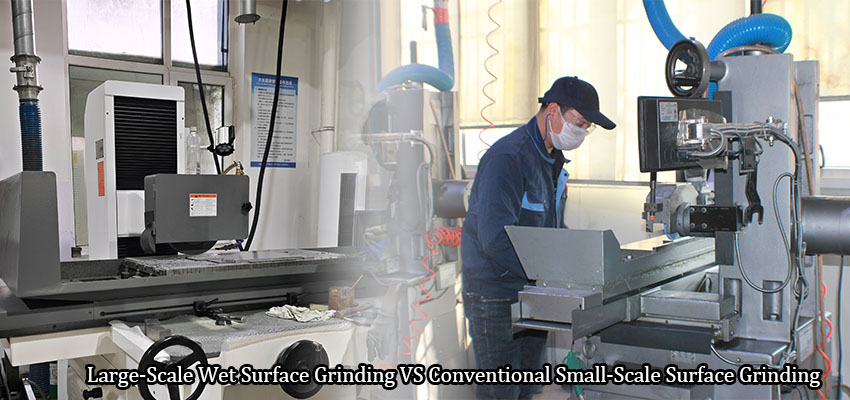
Key Differences Between Large-Scale Wet Surface Grinding and Small-Scale Surface Grinding
Workpiece Size and Grinding Capacity
One of the most obvious differences is the available working area and overall machining capacity.
Large-scale wet surface grinders are designed with larger worktables and greater grinding travel. They can accommodate large, heavy, or elongated workpieces and often allow a large surface to be ground in a continuous operation.
This is particularly advantageous for large mold bases, machine beds, precision plates, and structural components.
Conventional small surface grinders have more limited table dimensions and grinding travel. They are better suited to small and medium-sized components. When a workpiece exceeds the available grinding area, multiple setups or repositioning may be necessary.
Repeated repositioning can increase machining time and make it more difficult to maintain consistent flatness and dimensional relationships across the entire workpiece.
Grinding Efficiency
Large-scale wet surface grinding generally provides higher productivity when machining large surfaces.
Large-capacity machines can use suitable grinding wheels and optimized grinding parameters to remove material efficiently across a broad surface. Their rigid structure also helps maintain stable grinding conditions during extended operations.
Small surface grinders can be highly efficient when processing appropriately sized components. However, using a small machine for a large workpiece may require multiple setups, additional alignment, and repeated grinding operations.
For large-volume material removal or large-format components, this can significantly increase the overall processing time.
Cooling and Heat Control
Cooling is one of the most important considerations in surface grinding.
Grinding generates considerable heat in a relatively small contact area. If the heat is not controlled properly, the workpiece may experience thermal deformation, dimensional instability, or grinding burn.
Large-scale wet surface grinding machines are typically equipped with dedicated coolant circulation and filtration systems. A continuous flow of grinding fluid can cool the grinding zone while carrying away fine abrasive particles and grinding debris.
This is particularly important when machining large workpieces, where maintaining consistent temperature across the entire grinding area is essential.
Conventional small surface grinders may also be equipped with coolant systems, depending on the machine configuration and application. However, some smaller machines are used with simpler cooling arrangements or dry grinding for suitable materials and applications.
Therefore, the difference is not simply that large machines use coolant while small machines do not. The more important distinction is the capacity, stability, and continuous operation of the cooling system.
Machine Rigidity and Grinding Stability
Machine rigidity has a direct influence on grinding performance.
Large-scale surface grinders are generally constructed with heavier machine bases, larger worktables, and more robust structural components. This provides greater stability when processing large or heavy workpieces.
A rigid machine structure helps minimize vibration and maintain consistent grinding conditions, particularly during long grinding cycles.
Conventional small surface grinders are designed for lighter workpieces and smaller grinding loads. Within their intended operating range, they can provide excellent stability and precision.
However, when a small machine is used for a workpiece that approaches or exceeds its intended capacity, limitations related to table loading, machine rigidity, and grinding wheel size can become more significant.
Flatness and Dimensional Accuracy
Flatness, parallelism, and dimensional accuracy are among the most important requirements in precision surface grinding.
Large-scale grinding can offer an important advantage when machining large workpieces because a larger surface can often be processed with fewer setups.
Reducing the number of setups minimizes repositioning and alignment errors. This can make it easier to maintain consistent flatness and dimensional relationships across a large surface.
When a large workpiece must be processed on a small surface grinder, it may need to be repositioned several times. Even small alignment differences between setups can accumulate and affect overall flatness or parallelism.
However, machine size alone does not determine grinding accuracy. Actual results depend on machine condition, spindle accuracy, grinding wheel condition, workholding, coolant management, grinding parameters, material characteristics, and operator expertise.
Grinding Wheel Selection
Grinding wheel selection is another important factor in both large-scale and small-scale surface grinding.
The appropriate wheel depends on workpiece material, required surface finish, stock removal, grinding speed, and machine capability.
For precision finishing, a suitable abrasive type and grit size must be selected to balance material removal rate and surface quality.
In large-scale wet grinding, grinding wheels may be selected specifically for continuous high-productivity operations. Proper coolant delivery helps control grinding temperature and remove grinding debris from the wheel and workpiece.
For small precision components, finer grinding wheels may be selected when dimensional control and surface finish are more important than high material removal rates.
Regardless of machine size, incorrect wheel selection can result in excessive wheel wear, poor surface finish, grinding burn, or unstable dimensional accuracy.
Conclusion
Large-scale wet surface grinding and conventional small-scale surface grinding are both valuable processes in precision manufacturing, but they are designed for different production requirements.
Large-scale wet surface grinding is particularly advantageous for large and heavy workpieces, extensive grinding surfaces, demanding flatness requirements, and applications where stable cooling and high productivity are important. Its larger working capacity, rigid structure, and continuous coolant system make it well suited to mold bases, machine beds, large precision plates, and other large components.
Conventional small-scale surface grinding, on the other hand, provides a flexible and economical solution for small and medium-sized precision components. It is widely used for mold inserts, fixtures, tooling components, prototypes, and low-volume production.
The most appropriate grinding method should not be determined simply by machine size. Workpiece dimensions, material, grinding allowance, dimensional tolerances, surface finish, production volume, and setup requirements should all be considered.
By matching the grinding equipment to the actual requirements of the component, manufacturers can achieve the right balance between precision, productivity, surface quality, and manufacturing cost.