


When developing a new product, one of the most important decisions engineers and procurement teams must make is choosing the right manufacturing process. Two of the most common options are CNC machining and injection molding. Each method has its own advantages, but cost is often the deciding factor.
Understanding how costs are structured in CNC machining versus injection molding can help businesses select the most efficient and economical solution based on their production needs.
Understanding the Cost Structure of CNC Machining
CNC machining is a subtractive manufacturing process where material is removed from a solid block to create the final part. One of its biggest advantages is that it does not require molds or specialized tooling.
The cost of CNC machining is primarily driven by:
- Material cost
- Machining time
- Tool wear
- Labor and programming
Because there is no upfront tooling investment, CNC machining is highly cost-effective for low-volume production, prototyping, and custom parts. Companies can start production immediately after finalizing the CAD design, which also reduces lead time.
However, as production volume increases, the per-part cost remains relatively stable. This means CNC machining does not benefit significantly from economies of scale.
Understanding the Cost Structure of Injection Molding
Injection molding is a manufacturing process where molten material—typically plastic—is injected into a mold cavity to form parts. Unlike CNC machining, injection molding requires the creation of a mold before production begins.
The main cost components include:
- Mold design and manufacturing (high upfront cost)
- Material cost (usually lower per unit)
- Cycle time and machine operation
- Maintenance of molds
The initial tooling cost for injection molding can be substantial, often ranging from thousands to tens of thousands of dollars depending on complexity. However, once the mold is completed, the cost per part becomes very low, especially in high-volume production.
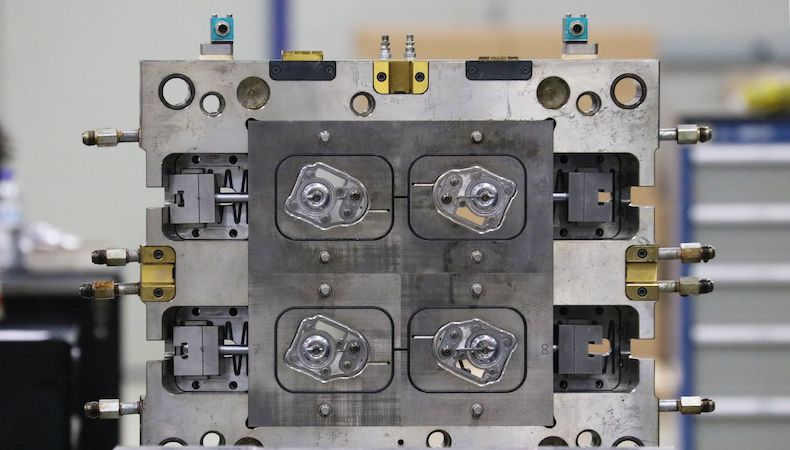
Cost Comparison Based on Production Volume
The most critical factor in choosing between CNC machining and injection molding is production volume.
For low-volume production, CNC machining is usually more cost-effective. Since there is no tooling investment, companies can produce small batches without significant financial risk. This makes CNC ideal for prototyping, product testing, and early-stage market validation.
As production volume increases, injection molding becomes more economical. Although the initial mold cost is high, it is distributed across a large number of parts, significantly reducing the cost per unit. For mass production, injection molding typically offers a much lower per-part cost than CNC machining.
The break-even point varies depending on part complexity, material, and tooling cost, but it often falls between a few hundred to several thousand units.
Lead Time and Development Speed
Speed is another important factor that indirectly affects cost.
CNC machining allows for immediate production once the design is ready. There is no need to wait for tooling, which makes it ideal for rapid prototyping and short lead-time projects.
Injection molding, on the other hand, requires time for mold design, manufacturing, and testing. This process can take several weeks or even months. However, once the mold is ready, production speed is extremely high, allowing large quantities of parts to be produced in a short period.
For companies that need to launch products quickly, CNC machining provides a clear advantage in the early stages.
Design Flexibility and Modification Costs
Design changes are common during product development, and the cost of modifications differs significantly between the two processes.
With CNC machining, design updates are relatively simple. Engineers only need to modify the CAD file and update the machining program. This flexibility makes CNC machining highly adaptable to iterative development.
In injection molding, however, design changes can be expensive. Even small modifications may require reworking or completely rebuilding the mold, leading to additional costs and delays.
This is why many companies use CNC machining during the prototyping phase and transition to injection molding once the design is finalized.
Material and Application Considerations
Material selection also influences cost efficiency.
CNC machining supports a wide range of materials, including metals such as aluminum, stainless steel, and titanium, as well as engineering plastics. This versatility makes it suitable for high-performance applications in aerospace, robotics, and industrial equipment.
Injection molding is primarily used for plastic parts. While it offers excellent consistency and surface finish, it is not suitable for metal components unless combined with secondary processes.
For products that require metal parts or high mechanical strength, CNC machining is often the preferred option despite higher per-unit costs.
Surface Finish and Post-Processing Costs
Surface finish requirements can also impact overall manufacturing cost.
CNC machining can achieve high-quality finishes directly, but additional processes such as anodizing, polishing, or coating may be required depending on the application.
Injection molding can produce parts with excellent surface finishes directly from the mold, especially when the mold surface is polished. This reduces the need for secondary finishing operations in many cases.
However, achieving high cosmetic quality in molds increases tooling cost upfront.
When to Choose CNC Machining
CNC machining is the better choice when:
Production volume is low or uncertain
- Rapid prototyping is required
- Design changes are expected
- Parts require metal materials
- Lead time must be minimized
It provides flexibility and reduces upfront financial risk.
When to Choose Injection Molding
Injection molding becomes the preferred option when:
- Production volume is high and stable
- Design is finalized
- Per-unit cost must be minimized
- Plastic materials are sufficient
- Long-term production efficiency is critical
It offers significant cost advantages in large-scale manufacturing.
Conclusion
CNC machining and injection molding each serve distinct roles in modern manufacturing. CNC machining excels in flexibility, speed, and low-volume production, while injection molding delivers unmatched cost efficiency in high-volume plastic part manufacturing.
The most cost-effective approach often involves using CNC machining during the early stages of product development and transitioning to injection molding once the design is stable and production demand increases.
By understanding the cost structure and production requirements of each process, businesses can make informed decisions that balance budget, performance, and time-to-market.