


In the world of high-precision manufacturing, traditional cutting tools—like drills and end mills—eventually hit a wall. When dealing with ultra-hard materials or geometries so intricate that no physical blade can reach them, engineers turn to a process that feels more like science fiction than traditional shop work: Electrical Discharge Machining (EDM).
Often referred to as “spark machining” or “wire erosion,” EDM has transitioned from a niche tool-room solution to a cornerstone of modern aerospace, medical, and automotive production. This article explores the mechanics, the three primary variations, and the strategic advantages of using EDM in contemporary engineering.
What Exactly is EDM Machining?
Unlike CNC milling or turning, which rely on mechanical force to shear material away, EDM is a thermal-electrical process. It removes material through a series of rapidly recurring electrical discharges (sparks) between two electrodes: the tool (the electrode) and the workpiece.
These components are submerged in a dielectric fluid, typically deionized water or oil. When the electrical potential between the tool and the workpiece reaches a specific threshold, the fluid breaks down, and a spark jumps the gap. Each spark generates localized temperatures ranging from 8,000°C to 12,000°C, vaporizing or melting a microscopic amount of the material. The dielectric fluid then flushes the debris away and cools the surface, preparing it for the next discharge.
The Three Pillars of EDM Technology
Modern manufacturing categorizes EDM into three distinct types, each suited for specific geometries and industrial requirements.
1. Wire Cut EDM (WEDM)
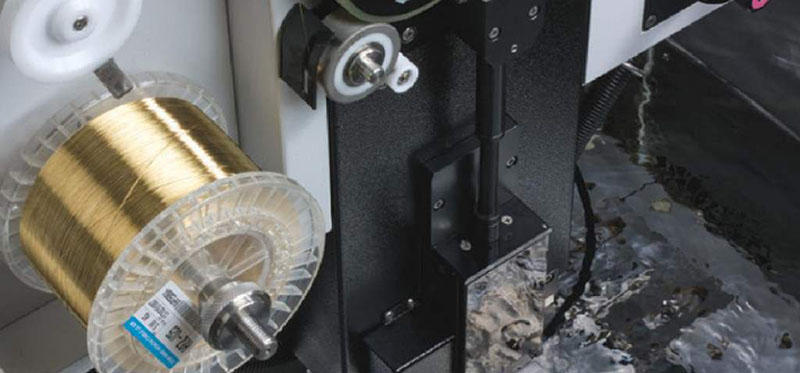
Often compared to a “cheese slicer” or a vertical bandsaw, Wire EDM uses a thin, continuously moving wire (usually brass or zinc-coated copper) as the electrode.
- How it Works: The wire is fed from a spool through the workpiece, following a CNC-programmed path. Because the wire is constantly being consumed and replaced, the “cutter” is always sharp and uniform.
- Best Use Cases: It is the gold standard for producing extrusion dies, blanking punches, and complex 2D shapes in thick plates.
- Key Advantage: With 5-axis capabilities, Wire EDM can create tapered cuts and varying top-and-bottom profiles, achieving tolerances as tight as +/- 0.0001 inches.
2. Sinker EDM (Ram or Cavity EDM)
- If Wire EDM is a saw, Sinker EDM is a stamp. This method uses a custom-machined electrode (often made of graphite or copper) that represents the “negative” of the desired shape.
- How it Works: The electrode is slowly lowered into the workpiece, “sinking” the spark-eroded pattern into the metal. This allows for the creation of blind cavities—holes that do not go all the way through the material.
- Best Use Cases: Sinker EDM is indispensable for the injection molding industry. It creates the complex, deep cavities in steel molds that would be impossible to reach with a rotating milling cutter.
- Key Advantage: It can produce sharp internal corners and intricate textures that mechanical tools cannot replicate.
3. Hole Drilling EDM
- While traditional drills struggle with hard materials or extreme depth-to-diameter ratios, EDM Drilling (or “Fast Hole” drilling) excels.
- How it Works: It uses a hollow, rotating tube electrode. Dielectric fluid is pumped through the center of the tube to flush out the intense amount of debris generated at the bottom of the deep hole.
- Best Use Cases: It is widely used to create cooling channels in turbine blades for jet engines and to provide “starter holes” for Wire EDM processes.
- Key Advantage: It can drill holes at steep angles on curved surfaces without the drill bit “walking” or breaking, and it maintains perfect roundness over long distances.
Technical Advantages: The EDM Edge
Choosing EDM over traditional machining is often a matter of technical necessity rather than cost. Here are the factors that make it superior in specific scenarios:
Precision and Surface Integrity
Because EDM is a non-contact process, it avoids the “burrs” and mechanical deformations typical of milling. The resulting surface finish is incredibly smooth and uniform, often appearing like a matte sandblasted finish (high-quality Ra levels). This reduces the need for secondary polishing.
Complexity Without Stress
Imagine trying to mill a thin, 0.5 mm wall in a heavy block of steel. The pressure of the cutter would likely bend or snap the wall. EDM applies zero macro-force, allowing for the creation of delicate lattices, thin ribs, and micro-features that are structurally sound.
Handling Extreme Hardness
In traditional machining, as a material gets harder, the tool wears out faster. In EDM, the hardness of the workpiece is irrelevant. A spark erodes hardened tool steel just as easily as it erodes soft aluminum, provided the conductivity is there.
The Historical Evolution
The concept of spark erosion was first noted by Joseph Priestley in 1770, but it wasn’t until the 1940s that researchers B.R. Lazarenko and N.I. Lazarenko in the USSR harnessed it for controlled manufacturing. They were looking for ways to extend the life of electrical contacts but realized the sparks could be used to “drill” into stubborn materials.
By the late 1960s and early 70s, the introduction of CNC (Computer Numerical Control) transformed EDM from a manual repair tool into a high-tech automated system, paving the way for the precision components we see in modern spacecraft and surgical instruments today.
Final Thoughts
EDM machining represents the pinnacle of material subtraction where traditional physics fails. While it may be slower than high-speed milling, its ability to ignore material hardness and produce “impossible” geometries makes it an essential tool in any advanced manufacturer’s arsenal. Whether you are creating a mold for a new consumer product or drilling cooling holes in a rocket engine, understanding the nuances between Wire, Sinker, and Hole EDM is the first step toward engineering excellence.