


Threaded holes are among the most common features found in CNC-machined components. They provide a reliable method for fastening parts together without requiring separate nuts, making them essential in industries such as aerospace, automotive, electronics, medical devices, and industrial equipment.
Although creating a threaded hole may seem straightforward, its design has a significant impact on manufacturability, assembly performance, and production cost. Factors such as thread type, hole depth, material selection, and machining method all influence the quality and durability of the finished part.
This article explains the different types of threaded holes used in CNC machining and outlines the key design considerations that help manufacturers achieve accurate, reliable, and cost-effective results.
What Is a Threaded Hole?
A threaded hole is a hole with internal threads that allow a screw, bolt, or threaded fastener to be securely installed. Internal threads are typically produced after drilling by tapping, thread milling, or other specialized machining processes.
Threaded holes eliminate the need for additional fastening hardware in many assemblies while providing a compact and reusable connection. They are widely used in mechanical structures where components must be assembled, disassembled, or maintained throughout their service life.
The design of a threaded hole should consider not only the required fastening strength but also the manufacturing process and the material being machined.
Common Types of Threaded Holes
Different applications require different threaded hole configurations. Selecting the appropriate type improves assembly efficiency and ensures the connection performs as intended.
Through Threaded Holes
A through threaded hole extends completely through the workpiece, allowing chips to exit during machining and making tapping relatively simple.
Because chips are easily evacuated, through holes generally reduce the risk of tap breakage and provide faster machining. They are commonly used in brackets, mounting plates, structural components, and other applications where access from both sides is available.
Blind Threaded Holes
Blind threaded holes do not pass through the entire workpiece. Instead, they terminate at a specified depth, making them suitable when the opposite side of the component must remain intact.
Although widely used, blind holes require greater machining accuracy. Chips tend to accumulate at the bottom of the hole, increasing the difficulty of tapping and requiring careful control of thread depth. Designers should also provide sufficient clearance below the threads to accommodate the tap and remaining chips.
Tapered Threaded Holes
Tapered threads gradually decrease in diameter along their length, creating a tight mechanical seal as the mating thread is installed.
These threaded holes are commonly used in piping systems, hydraulic equipment, and pneumatic fittings where leakage prevention is critical. The tapered profile allows the threads themselves to create the sealing force without relying solely on additional sealing components.
Threaded Inserts
In some materials, especially aluminum, plastics, and other relatively soft metals, threaded inserts are used to improve thread strength and wear resistance.
Rather than machining threads directly into the base material, an insert containing hardened internal threads is installed after machining. This approach increases durability and allows repeated assembly without damaging the surrounding material.
Threaded inserts are frequently used in aerospace components, electronic enclosures, and products that require frequent maintenance.
Choosing the Right Thread Standard
Thread standards vary depending on the industry and geographic region.
Metric threads are the most widely used internationally and are commonly specified in ISO standards. Unified National threads (UNC and UNF) remain common in North America, while pipe thread standards such as NPT and BSP are widely used for fluid systems.
Selecting the appropriate standard ensures compatibility with commercially available fasteners and simplifies maintenance throughout the product’s service life.
Whenever possible, designers should avoid mixing thread standards within the same assembly, as this increases the risk of installation errors.
Thread Depth Considerations
Thread depth is one of the most important design factors affecting both manufacturing efficiency and joint strength.
Many designers assume that deeper threads always produce stronger connections. In reality, once adequate thread engagement has been achieved, additional depth often provides little improvement while increasing machining time and tooling wear.
As a general guideline, a thread engagement length approximately equal to one to one and a half times the fastener diameter is sufficient for most steel components. Softer materials may require slightly longer engagement to achieve comparable holding strength.
Excessively deep threaded holes also make chip evacuation more difficult, particularly when tapping blind holes.
Selecting the Appropriate Machining Method
Several manufacturing methods can be used to create internal threads, and the best choice depends on the application, material, and production volume.
Tapping remains the most common process because it is fast, economical, and well suited for standard thread sizes. It is widely used in high-volume production where efficiency is important.
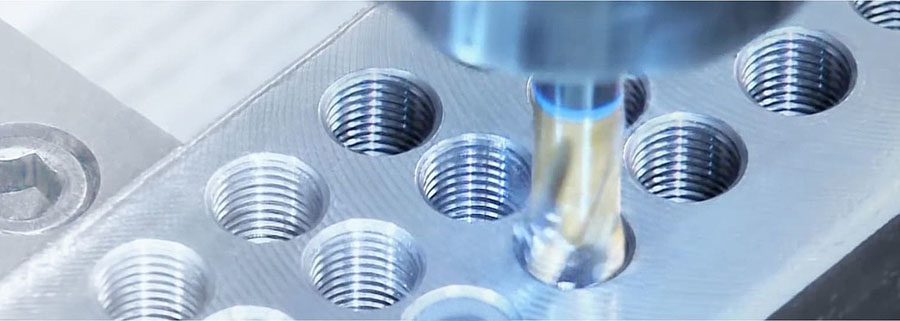
Thread milling offers greater flexibility and precision. Instead of cutting the entire thread profile in one operation, a thread mill gradually interpolates the thread using CNC-controlled toolpaths. This process reduces cutting forces and allows different thread sizes to be produced with fewer tools.
Thread milling is especially advantageous for large-diameter threads, difficult materials, and high-value components where tool breakage must be minimized.
For certain ductile materials, thread forming may also be used. Unlike cutting taps, forming taps displace material to create threads without producing chips. This process often results in stronger threads and improved surface finish while eliminating chip removal issues.
Material Selection Affects Thread Quality
The workpiece material has a direct influence on thread machining performance.
Steel and stainless steel generally produce strong, durable threads but may require slower cutting speeds and higher-quality tooling. Aluminum machines easily, although its relatively low strength often makes threaded inserts beneficial for heavily loaded connections.
Titanium and nickel-based alloys present greater machining challenges because of their strength and heat generation during cutting. Proper tool selection and optimized machining parameters are essential when threading these materials.
Plastics and composite materials may also require specialized thread designs to prevent stripping or deformation during assembly.
Design for Manufacturability
Thoughtful thread design can significantly reduce machining costs while improving production efficiency.
Whenever possible, designers should use standard thread sizes rather than custom dimensions. Standard taps and thread mills are readily available, reducing tooling costs and lead times.
Blind holes should include adequate clearance below the threaded section to accommodate the tap and allow chips to accumulate safely. This improves thread quality and reduces the likelihood of tool failure.
Avoid specifying unnecessarily tight thread tolerances unless required by the application. Standard tolerance classes typically provide sufficient performance while simplifying manufacturing and inspection.
Designers should also ensure that threaded holes are accessible to machining tools. Threads located too close to walls, corners, or complex features may require specialized tooling, increasing production costs.
Common Problems and How to Prevent Them
Threaded holes may develop quality issues if machining parameters or designs are not properly optimized.
Burrs around hole entrances can interfere with assembly and should be removed through chamfering or deburring operations. Poor chip evacuation, particularly in blind holes, may cause broken taps or damaged threads.
Improper tool alignment can produce oversized or undersized threads that fail inspection. Likewise, worn cutting tools may reduce thread accuracy and surface quality.
Regular tool inspection, appropriate cutting parameters, and effective coolant application all contribute to producing consistent, high-quality threaded holes.
Conclusion
Threaded holes are fundamental features in CNC-machined parts, providing secure and efficient fastening solutions across countless industries. While they appear simple, their design directly influences manufacturing cost, assembly performance, and long-term reliability.
By selecting the appropriate thread type, using standard thread specifications, optimizing thread depth, and considering material characteristics during the design stage, manufacturers can improve machining efficiency while producing stronger and more reliable threaded connections.
Careful attention to manufacturability not only simplifies production but also reduces tooling costs, minimizes machining problems, and ensures that threaded holes perform consistently throughout the life of the finished product.