
Plastic components play an important role in modern automation systems and industrial production equipment. From conveyor guides and sliding components to wear strips, rollers, and machine fixtures, engineered plastics offer a combination of low friction, wear resistance, chemical resistance, and lightweight construction that makes them suitable for demanding operating environments.
However, not all plastics perform equally well under continuous friction, repeated contact, or mechanical loading. Selecting the wrong material can lead to premature wear, dimensional changes, excessive friction, or unexpected equipment downtime.
CNC plastic machining provides a flexible way to manufacture custom components with precise dimensions and functional features. By selecting suitable engineering plastics and controlling machining parameters, manufacturers can produce parts designed to withstand repeated movement and prolonged use in industrial environments.
This article explores the benefits of CNC plastic machining for high-wear automation and production equipment, common material options, important machining considerations, and factors that affect component performance and manufacturing costs.
Why Use CNC Machined Plastic Parts in High-Wear Applications?
High-wear applications often involve repeated sliding contact, rotating movement, friction between mating surfaces, or continuous material handling. In these environments, component material selection directly affects service life, maintenance requirements, and equipment reliability.
Engineered plastics offer several advantages over conventional metal components, depending on the application.
Low Friction and Wear Resistance
Certain engineering plastics have naturally low coefficients of friction and good wear resistance, making them suitable for sliding surfaces, guide rails, bushings, and wear pads.
Materials such as UHMW-PE, acetal (POM), and specialized bearing-grade nylon can reduce friction and help minimize wear during repeated movement. Some grades also offer self-lubricating characteristics, reducing or eliminating the need for external lubrication under suitable operating conditions.
However, wear performance depends on more than the material alone. Contact pressure, sliding speed, surface finish, temperature, lubrication, and the mating material all influence the actual service life of a component.
Lightweight Construction
Plastic components are generally lighter than comparable steel components. Reducing moving mass can help improve the responsiveness of automation equipment and reduce the load placed on drive systems, depending on the design.
Lightweight plastic parts are useful in robotic handling equipment, conveyor systems, packaging machinery, and automated positioning mechanisms where frequent acceleration and deceleration occur.
Corrosion and Chemical Resistance
Unlike many unprotected metals, selected engineering plastics resist moisture, corrosion, and certain industrial chemicals. This makes them useful in equipment exposed to water, cleaning agents, coolants, and other process fluids.
Chemical resistance varies significantly by polymer grade, concentration, temperature, and exposure duration. Material compatibility should therefore be evaluated against the actual operating environment rather than assumed from the generic plastic type.
Reduced Maintenance Requirements
Plastic wear components can help reduce maintenance needs by lowering friction, resisting corrosion, and simplifying replacement in certain applications.
The maintenance benefits depend on the component design, operating conditions, and expected wear rate.
Best CNC Plastic Materials for High-Wear Automation Equipment
Choosing the right plastic is essential for balancing wear resistance, mechanical strength, dimensional stability, and manufacturing cost. Different materials are suited to different combinations of load, speed, temperature, and environmental exposure.
UHMW-PE for Sliding Guides and Wear Strips
Ultra-high-molecular-weight polyethylene (UHMW-PE) is widely used in applications requiring low friction, impact resistance, and strong abrasion resistance.
Its typical applications include conveyor wear strips, sliding guides, chain guides, liners, and material-handling components. The material’s low friction helps moving products or mechanical elements travel along contact surfaces with reduced resistance.
UHMW-PE is particularly useful where components experience repeated sliding contact and moderate mechanical loads. However, it has relatively low stiffness compared with many engineering plastics and can deform under sustained loads. Its dimensional stability and suitability for tight-tolerance features should be evaluated carefully.
Acetal (POM) for Precision Moving Components
Acetal, also known as polyoxymethylene (POM), is a common choice for precision plastic components requiring good stiffness, low friction, and dimensional stability.
It is used for bushings, rollers, gears, guide blocks, positioning components, and other parts that require consistent dimensions during repeated movement.
Compared with UHMW-PE, POM generally offers greater rigidity and better dimensional stability for precision-machined features. It can be a suitable choice when a component must maintain clearances or alignment during operation.
The specific POM grade should be selected according to the required wear performance, operating temperature, and exposure to chemicals or moisture.
Nylon for Load-Bearing Wear Components
Nylon, including PA6 and PA66, offers good mechanical strength, toughness, and abrasion resistance. It is frequently used for rollers, wear pads, gears, bushings, and machine components exposed to repeated mechanical contact.
Nylon can be suitable for applications where components need to withstand relatively high loads while maintaining useful wear resistance.
One important consideration is moisture absorption. Nylon can absorb moisture from its surroundings, causing dimensional changes and affecting stiffness and mechanical properties. For precision components, the operating environment and conditioning state should be considered when establishing tolerances.
PTFE for Low-Friction Components
Polytetrafluoroethylene (PTFE) is known for its very low friction and broad chemical resistance. It is used in sliding elements, seals, liners, and components that require low resistance to movement.
However, unfilled PTFE has relatively low stiffness and can deform or creep under sustained loads. It may not be the best option for structural wear components that must retain tight dimensions under continuous pressure.
Filled PTFE grades can provide improved wear resistance or mechanical performance for certain applications, but the appropriate grade depends on the required properties and operating conditions.
PEEK for Demanding Industrial Environments
Polyether ether ketone (PEEK) is a high-performance engineering thermoplastic offering high temperature resistance, good mechanical strength, and chemical resistance.
Selected PEEK grades are used for precision machine components, bushings, wear parts, and automation components operating under demanding thermal or mechanical conditions.
Although PEEK can provide advantages in specialized applications, its material cost is considerably higher than that of many conventional engineering plastics. It is most appropriate when the required operating conditions justify the additional expense.
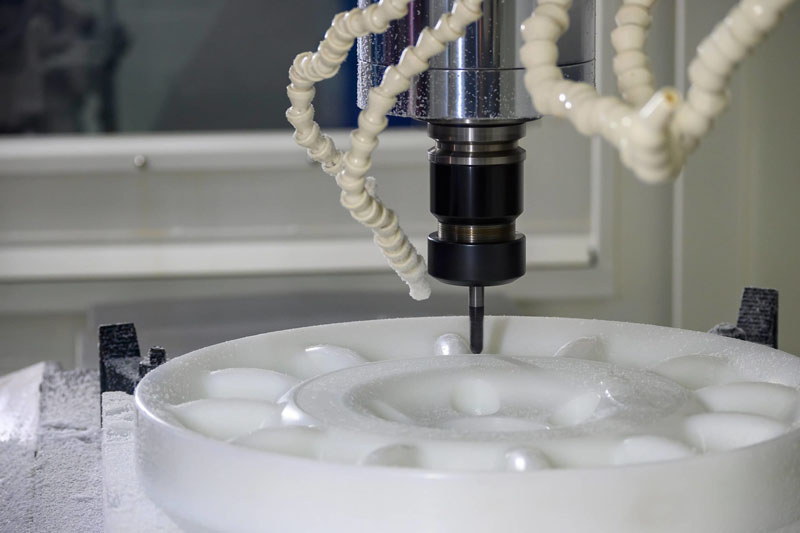
Common CNC Machined Plastic Components for Automation Systems
CNC plastic machining supports the production of many custom components used in automated machinery and industrial production lines.
Conveyor Guides and Wear Strips
Conveyor systems often require guide rails and wear strips to control product movement and protect the supporting structure. These components may experience continuous sliding contact with packages, containers, chains, or other moving elements.
UHMW-PE is a common choice because of its abrasion resistance and low friction. Depending on the design, CNC machining can produce the required mounting holes, slots, contours, and connection features.
Bushings and Bearings
Plastic bushings and sliding bearing components can provide low-friction movement between mating parts. They are used in packaging equipment, material-handling systems, assembly machinery, and other applications where controlled movement is required.
POM, nylon, and specialized bearing-grade plastics may be suitable depending on load, speed, temperature, and lubrication conditions.
Rollers and Guide Wheels
Custom plastic rollers and guide wheels help direct materials or components through production equipment. Their performance depends on dimensional accuracy, concentricity, surface finish, and resistance to wear.
CNC turning is particularly useful for producing cylindrical components with controlled diameters, bores, grooves, and mounting features.
Wear Pads and Sliding Blocks
Wear pads and sliding blocks protect machine frames and support moving components. They are commonly used in positioning mechanisms, assembly systems, and automated handling equipment.
Material selection should account for contact pressure, sliding speed, rigidity, and the possibility of debris becoming trapped between sliding surfaces.
Custom Fixtures and Positioning Components
Automation equipment often requires custom fixtures, nests, stops, spacers, and positioning blocks to locate products or components accurately during production.
CNC machined plastics can provide a combination of dimensional precision, low weight, and surface protection. They are especially useful when metal fixtures might scratch delicate products or create unwanted electrical contact.
Key Machining Considerations for CNC Plastic Parts
Machining plastics requires different process considerations from machining metals. Plastics have lower thermal conductivity, different stiffness characteristics, and greater sensitivity to temperature and clamping forces in many applications.
Without appropriate process control, a component may develop burrs, surface defects, dimensional variation, or deformation after machining.
Heat Generation and Thermal Expansion
Plastic materials can soften or deform when excessive heat accumulates during machining. Heat may come from cutting friction, dull tools, unsuitable cutting speeds, or poor chip evacuation.
Thermal expansion can also cause dimensional differences between a warm part during machining and the same part after cooling.
Sharp cutting tools, suitable feeds and speeds, and effective chip removal help reduce heat buildup. Where necessary, machining parameters and inspection procedures should account for the material’s thermal behavior.
Workholding and Part Deformation
Many plastics are less rigid than metals, making them more susceptible to deformation under clamping pressure.
Excessive clamping force can distort thin walls, rings, and other delicate geometries. The part may appear dimensionally correct while clamped but change shape after removal.
Suitable fixtures, properly distributed clamping forces, and machining sequences that minimize stress can help reduce this problem. For thin-walled or large plastic components, inspection after unclamping is particularly important.
Dimensional Tolerances and Material Stability
Not every plastic material can maintain the same tolerances under all operating conditions. Moisture absorption, temperature changes, internal stresses, and sustained mechanical loads can affect dimensions over time.
When designing precision plastic components, tolerances should reflect both the material’s properties and the actual operating environment. Critical dimensions may require additional verification after the part has stabilized under specified conditions.
Burr Formation and Surface Finish
Plastic machining can produce burrs, stringy chips, or rough edges if the cutting tool geometry and machining parameters are unsuitable.
Sharp tools designed for plastics, appropriate chip loads, and stable workholding can help improve surface quality. Additional deburring may be necessary for edges, holes, and slots.
For sliding components, surface finish should be selected according to the functional requirements. A smoother surface is not automatically better in every wear application; the appropriate finish depends on the mating material, lubrication conditions, and contact behavior.
How to Improve Wear Life in CNC Machined Plastic Components
The service life of a plastic wear component depends on the combined effects of material selection, component design, machining quality, and operating conditions.
First, select a material that matches the actual load, sliding speed, temperature, and environmental exposure. A low-friction material may perform well in one application but deform too easily in another.
Second, consider the contact geometry. Increasing the effective contact area may reduce contact pressure, while avoiding sharp transitions and stress concentrations can improve component durability.
Third, ensure that the mating surfaces are appropriate. Rough metal surfaces, misalignment, abrasive contamination, or uneven loading can accelerate plastic wear even when the selected polymer has good wear resistance.
Fourth, account for thermal expansion and dimensional changes. Adequate clearances can help prevent interference as the component warms during operation.
Finally, establish a practical inspection and replacement schedule for components exposed to continuous wear. Monitoring wear patterns can help identify whether a problem originates from the material, alignment, contact pressure, or machining accuracy.
What Affects the Cost of CNC Plastic Machining?
The cost of CNC machined plastic components depends on several factors beyond the price of the raw material.
Material selection: POM, nylon, and UHMW-PE are commonly used engineering plastics, while PEEK and specialized filled grades may carry substantially higher material costs.
Part geometry: Thin walls, deep pockets, complex profiles, and small internal features can increase programming and machining time.
Tolerance requirements: Tight tolerances may require additional machining stages, more careful workholding, and further dimensional inspection.
Material waste: Components machined from solid plastic stock can generate significant scrap, particularly when the finished part has a complex shape or a low material utilization rate.
Production quantity: Prototype and low-volume orders may have higher unit costs because programming and setup expenses are distributed across fewer parts. Larger batches can reduce the setup cost per unit when the production process remains consistent.
Finishing and inspection: Deburring, surface finishing, dimensional checks, and documentation requirements may increase the overall project cost.
Providing complete drawings, material specifications, expected quantities, and critical tolerances helps manufacturers prepare an accurate quotation and identify opportunities to reduce unnecessary machining costs.
Quality Inspection for CNC Machined Plastic Parts
Quality inspection is important for ensuring that plastic components meet their dimensional and functional requirements. This is particularly relevant for automation equipment, where excessive clearance, misalignment, or dimensional instability can affect the operation of an entire assembly.
Depending on the part design, inspection may include checking overall dimensions, hole diameters, thickness, flatness, concentricity, and other specified features.
Measuring methods should be appropriate for the material. Because some plastics can deform under contact pressure or change dimensions with temperature and moisture, inspection conditions and handling procedures may need special attention.
For parts with critical tolerances, the inspection plan should identify the required measurement methods and acceptance criteria in advance. Inspection reports can be provided according to the agreed project requirements.
Choosing a CNC Plastic Machining Partner
When sourcing custom plastic components for automation and production equipment, it is important to work with a manufacturer that understands both machining requirements and material behavior.
A suitable manufacturing partner should be able to review engineering drawings, evaluate material options, identify potential deformation or tolerance challenges, and recommend an appropriate machining process.
Experience with different engineering plastics is especially valuable when the component must withstand continuous movement, repeated contact, or demanding environmental conditions.
Clear communication about the application, expected service life, operating temperature, contact loads, and inspection requirements helps ensure that the selected material and manufacturing process are appropriate for the intended use.
Conclusion
CNC plastic machining provides a flexible solution for manufacturing custom wear-resistant components used in automation systems and industrial production equipment. Materials such as UHMW-PE, POM, nylon, PTFE, and PEEK offer different combinations of low friction, wear resistance, mechanical strength, chemical resistance, and temperature performance.
Achieving reliable service life requires more than selecting a wear-resistant plastic. Machining parameters, workholding, dimensional tolerances, thermal behavior, and the conditions at the contact surfaces all influence the finished component’s performance.
By evaluating these factors during design and manufacturing, businesses can produce plastic components that support reliable movement, reduce unnecessary maintenance, and meet their equipment’s functional requirements.