


Bringing a product from concept to market rarely jumps directly from a prototype to mass production. For many industries—including aerospace, medical devices, robotics, automotive, industrial equipment, and consumer electronics—low-volume manufacturing serves as the critical bridge between product development and full-scale production.
Small-batch manufacturing allows engineers to validate designs, test market demand, optimize production processes, and reduce investment risks before committing to expensive tooling or high-volume production. However, a successful transition requires much more than simply machining additional parts. Design optimization, material selection, manufacturing strategy, quality control, and supply chain planning all become increasingly important as production scales from one prototype to hundreds or thousands of components.
This guide explains how manufacturers can efficiently prepare custom CNC machined parts for low-volume production while maintaining quality, controlling costs, and shortening lead times.
Why Low-Volume Manufacturing Matters
Many companies mistakenly assume that prototypes and production parts require the same manufacturing approach. In reality, the objectives are quite different.
Prototype machining focuses primarily on verifying functionality and design feasibility. Speed is often the highest priority, while machining cost and production efficiency receive less attention.
Low-volume manufacturing, however, introduces new considerations. Parts must be produced consistently, repeatedly, and economically while meeting strict dimensional and quality requirements. Manufacturing stability becomes just as important as machining accuracy.
For startups, product developers, and established manufacturers launching new products, low-volume production offers several advantages. It minimizes inventory risks, accelerates product launches, allows engineering changes without significant financial loss, and provides valuable customer feedback before large-scale manufacturing begins.
Evaluate the Prototype Before Scaling Up
A prototype proves that a design can work, but it does not necessarily prove that it can be manufactured efficiently.
Before entering small-batch production, engineers should carefully review every aspect of the prototype. Dimensions, tolerances, material selection, surface finish requirements, assembly performance, and machining complexity should all be reassessed from a manufacturing perspective.
Many prototype designs include unnecessary features that increase machining time without improving product performance. Extremely tight tolerances, deep internal pockets, sharp internal corners, and difficult tool access may all be acceptable for a single prototype but become expensive during repeated production.
Design optimization at this stage can significantly reduce manufacturing costs without affecting functionality.
Optimize the Design for Manufacturability (DFM)
One of the most effective ways to prepare for low-volume production is by applying Design for Manufacturability (DFM) principles.
A well-optimized design reduces machining time, improves production consistency, minimizes scrap, and simplifies quality inspection.
Engineers should evaluate whether tolerances are realistically necessary across every feature. Tight tolerances should only be specified where they directly affect assembly or performance. Standardizing hole sizes, thread specifications, corner radii, and wall thicknesses also simplifies programming and tooling.
Deep cavities requiring long cutting tools should be minimized whenever possible, as they increase machining vibration and reduce tool life. Likewise, avoiding unnecessary cosmetic features can shorten machining cycles and improve overall production efficiency.
Small design adjustments often produce significant savings once production quantities increase.
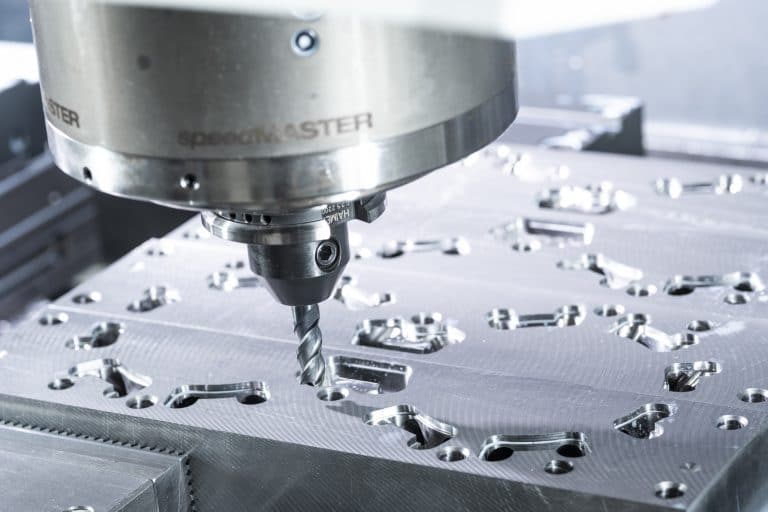
Select the Right Material for Production
Material selection during prototyping may prioritize availability or machining convenience, but production requires a broader evaluation.
Mechanical properties, corrosion resistance, heat treatment compatibility, machining efficiency, raw material cost, and supply stability should all be considered.
For aluminum components, alloys such as 6061-T6 provide an excellent balance between strength, machinability, and cost, making them ideal for many production applications. Stainless steels like 304 or 316 offer excellent corrosion resistance but generally require longer machining times than aluminum.
Engineering plastics such as POM (Delrin), PEEK, Nylon, and PTFE each provide unique advantages depending on mechanical requirements, chemical resistance, and operating temperature.
Choosing a material with reliable global availability also helps prevent supply chain disruptions during future production expansion.
Standardize CNC Machining Processes
Prototype machining often involves manual adjustments, multiple setup changes, and operator experience. These methods may work for one or two parts but become inefficient during batch production.
Low-volume manufacturing requires standardized machining processes that can be repeated consistently.
Stable CNC programs, optimized cutting parameters, standardized fixture designs, and documented setup procedures all contribute to improved repeatability. Tool selection should also prioritize durability and machining efficiency rather than simply achieving acceptable results on a single part.
Reducing setup time becomes increasingly valuable as production quantities increase, even when manufacturing only a few hundred components.
Design Efficient Workholding Fixtures
Workholding plays a critical role in production consistency.
Prototype parts are often secured using universal vises or simple clamps, but repeated production benefits greatly from dedicated fixtures.
Custom fixtures reduce setup time, improve positioning accuracy, minimize operator variation, and increase machining repeatability. Well-designed fixtures also reduce deformation on thin-wall components and improve surface finish by providing better support during cutting.
Although fixture design represents an additional upfront investment, it often pays for itself quickly through shorter cycle times and reduced labor costs.
Balance Precision and Manufacturing Cost
One of the most common challenges in small-batch production is overengineering.
Not every feature requires micron-level precision. Specifying unnecessarily tight tolerances increases machining time, inspection requirements, and production costs without providing additional value.
Critical dimensions affecting assembly, sealing, bearing fits, or motion should receive tighter tolerances, while non-functional surfaces can often use standard machining tolerances.
Similarly, mirror-like surface finishes should only be specified where required. Standard CNC machining finishes are sufficient for many industrial applications and help reduce unnecessary secondary processing.
Finding the right balance between performance and manufacturing cost is essential for competitive production.
Plan Surface Finishing Early
Surface finishing should be considered during product development rather than after machining has been completed.
Processes such as anodizing, electroplating, powder coating, polishing, bead blasting, passivation, and heat treatment can affect dimensions, appearance, corrosion resistance, and mechanical performance.
Some coatings increase part thickness, requiring machining dimensions to be adjusted beforehand. Heat treatment may also introduce slight dimensional changes that should be considered during process planning.
By incorporating finishing requirements into the machining strategy from the beginning, manufacturers can avoid costly rework and ensure consistent final quality.
Establish a Reliable Quality Control Process
Quality inspection becomes increasingly important as production volume grows.
Rather than inspecting only the finished parts, manufacturers should implement inspection throughout the production process. Incoming material verification, first article inspection, in-process measurement, and final inspection all help identify issues before large numbers of parts are affected.
Critical dimensions can be monitored using CMM inspection, coordinate measurement systems, optical inspection equipment, or precision gauges depending on part geometry and tolerance requirements.
For industries such as aerospace and medical manufacturing, complete inspection records and material traceability may also be required to satisfy customer or regulatory requirements.
A robust quality management process ensures consistency from the first part to the last.
Prepare for Future Production Scaling
Low-volume manufacturing should not be viewed as the final destination. Instead, it should establish a solid foundation for future mass production.
Production documentation—including machining programs, fixture designs, inspection procedures, tooling lists, and process parameters—should all be standardized and archived. These records make future production expansion significantly faster while reducing engineering changes and manufacturing risks.
Designing production workflows with scalability in mind also makes it easier to transition from hundreds of parts to thousands without major process modifications.
Partner with an Experienced CNC Manufacturing Supplier
Choosing the right manufacturing partner is often just as important as optimizing the product design.
An experienced CNC machining supplier can provide valuable Design for Manufacturability (DFM) feedback before production begins, helping identify potential machining challenges, unnecessary costs, or opportunities for process improvement.
Suppliers with comprehensive manufacturing capabilities—including CNC milling, CNC turning, multi-axis machining, surface finishing, heat treatment, assembly, and quality inspection—can streamline the entire production process while reducing lead times and logistics complexity.
A reliable manufacturing partner should also offer flexible production capacity, allowing customers to scale from prototype quantities to low-volume manufacturing and eventually to full production without changing suppliers.
Common Challenges When Moving from Prototype to Low-Volume Production
Many companies encounter unexpected obstacles during this transition. Designs that perform well as prototypes may prove difficult or expensive to manufacture repeatedly. Material lead times can increase as production quantities grow, while inconsistent machining setups may introduce dimensional variation between batches.
Another common issue is inadequate documentation. Without standardized machining instructions, tooling information, inspection criteria, and revision control, production consistency becomes difficult to maintain. Investing time in process documentation during the early stages helps prevent costly delays and quality issues later.
Recognizing these challenges early enables manufacturers to develop a more efficient and predictable production workflow.
Conclusion
The transition from prototype to low-volume manufacturing is one of the most important stages in the product development lifecycle. Success depends not only on producing accurate parts but also on creating a repeatable, efficient, and cost-effective manufacturing process.
By optimizing designs for manufacturability, selecting appropriate materials, standardizing machining procedures, improving workholding methods, planning surface finishing in advance, and implementing comprehensive quality control, manufacturers can significantly reduce production risks while improving product consistency.
Low-volume CNC manufacturing provides companies with the flexibility to validate products, respond quickly to market demand, and refine production processes before investing in full-scale manufacturing. With careful planning and the support of an experienced CNC machining partner, businesses can move from prototype to production with greater confidence, lower costs, and a stronger foundation for long-term success.