


Laser technology has become an essential solution for industrial identification, product customization, and precision manufacturing. Among the most common laser-based processes, laser marking and laser engraving are widely used for creating permanent text, logos, serial numbers, barcodes, and decorative patterns on various materials.
Although these two processes are often confused, they are not identical. Laser marking typically modifies the surface of a material without significant material removal, while laser engraving removes material to create a visible physical indentation. The differences between these methods affect durability, appearance, production speed, and application suitability.
Understanding the characteristics of laser marking and laser engraving helps manufacturers select the most appropriate process for their specific requirements.
What Is Laser Marking?
Laser marking is a process that uses a focused laser beam to alter the surface properties of a material and create permanent markings. Instead of cutting into the workpiece, the laser changes the material’s appearance through processes such as discoloration, oxidation, carbonization, or surface modification.
During laser marking, the laser energy interacts with the material surface and creates a high-contrast mark while maintaining the original surface structure. Because the process removes little or no material, it is suitable for applications where part integrity and precision are critical.
Common laser marking methods include:
- Annealing marking
- Color change marking
- Carbon migration marking
- Foaming marking
- Laser ablation marking
The specific method depends on the material type and the desired marking effect.
Laser marking is widely used for industrial traceability because it can produce highly accurate and permanent information without weakening the component.
What Is Laser Engraving?
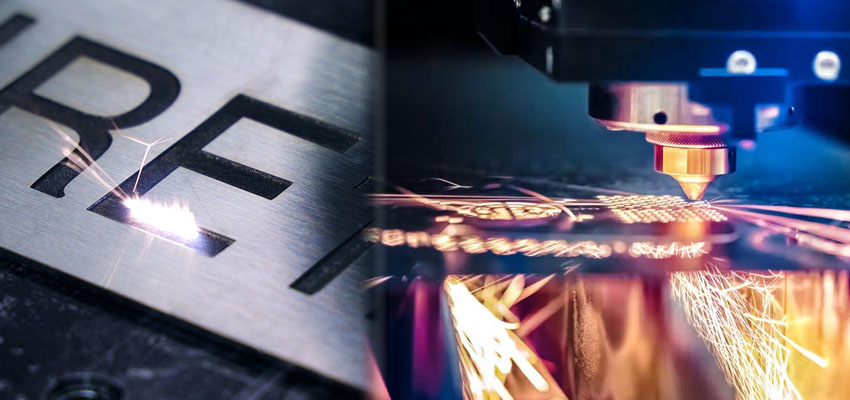
Laser engraving is a subtractive manufacturing process that uses a high-powered laser beam to remove material from the surface of a workpiece. The laser vaporizes or melts the material, creating a recessed cavity that forms the desired design or information.
Unlike laser marking, engraving produces a physical depth that can be felt by touch. This makes engraved markings highly durable and resistant to wear, making them suitable for components exposed to harsh operating environments.
The engraving depth depends on factors such as laser power, material properties, processing speed, and the number of passes performed.
Laser engraving is commonly used for:
- Deep identification marks
- Decorative patterns
- Industrial labels
- Mold and tooling identification
- Customized products
Because engraving physically changes the surface, it provides excellent long-term visibility even under abrasion or repeated handling.
Key Differences Between Laser Marking and Laser Engraving
Although both processes use focused laser energy, their operating principles and results are different.
Material Removal
The primary difference between laser marking and engraving is how they interact with the material.
Laser marking mainly modifies the surface layer without creating significant depth. The process changes the color, texture, or chemical composition of the surface while preserving the original geometry.
Laser engraving removes material and creates a recessed feature. The depth can range from a few microns to several millimeters depending on the application.
This difference makes laser marking better suited for precision components where dimensional changes must be avoided, while engraving is preferred when deeper and more permanent identification is required.
Durability and Wear Resistance
Both processes create permanent markings, but their durability differs depending on the environment.
Laser engraving generally provides higher resistance to mechanical wear because the marking exists below the original surface level. It remains visible even after exposure to abrasion, cleaning, or harsh industrial conditions.
Laser marking provides excellent durability for many applications, but because it primarily affects the surface, extremely abrasive environments may gradually reduce visibility.
For aerospace components, automotive parts, and industrial tools exposed to heavy wear, engraving is often preferred. For electronic components and medical devices where surface integrity is important, laser marking is usually more suitable.
Processing Speed
Laser marking is typically faster than engraving because it requires less energy and involves minimal material removal.
High-speed laser marking systems can process large quantities of components efficiently, making them ideal for mass production environments.
Laser engraving generally requires slower processing speeds because the laser must remove material to achieve the required depth. Multiple passes may be necessary for deeper engravings, increasing production time.
For high-volume applications where only identification information is required, laser marking often provides a more economical solution.
Surface Impact
Laser marking has minimal impact on the workpiece because it does not significantly alter surface geometry. This makes it suitable for precision parts with strict dimensional requirements.
Laser engraving creates a physical cavity that may affect surface structure. While this is beneficial for durability, manufacturers must consider whether material removal could influence strength, corrosion resistance, or sealing performance.
Materials Suitable for Laser Marking and Engraving
Both laser marking and engraving can be applied to a wide range of materials, but the ideal process depends on the material characteristics.
Metals
Metals such as aluminum, stainless steel, titanium, brass, and copper are commonly processed using laser technology.
Laser marking is frequently used for serial numbers, QR codes, barcodes, and traceability information on metal components. Annealing marking on stainless steel is especially popular in medical and aerospace applications because it creates high-contrast markings without damaging the surface.
Laser engraving is commonly used for deeper identification on tools, machine components, nameplates, and industrial equipment where long-term visibility is required.
Plastics
Laser marking is widely used on engineering plastics such as ABS, polycarbonate, acrylic, and nylon. Different plastics respond differently to laser energy, producing effects such as color changes, foaming, or surface modification.
Laser engraving can also be performed on plastics when deeper decorative or functional features are required.
Wood, Glass, and Other Materials
Laser engraving is particularly popular for wood, leather, glass, and acrylic products because it allows detailed decorative patterns and customized designs.
Applications include personalized gifts, signage, artistic products, and architectural elements.
Applications of Laser Marking
Laser marking plays an important role in industries where traceability and identification are essential.
In the automotive industry, manufacturers use laser marking to apply part numbers, production dates, safety information, and tracking codes to components.
The aerospace industry relies on laser marking for permanent identification of critical parts while maintaining strict dimensional requirements.
Medical device manufacturers use laser marking to comply with regulatory requirements for device identification and traceability. Markings must remain readable throughout sterilization and repeated use.
The electronics industry also benefits from laser marking because it can create extremely small, precise markings on circuit boards, connectors, and semiconductor components.
Applications of Laser Engraving
Laser engraving is commonly used when deeper, more durable markings are required.
Industrial tools and machinery often use engraving to display model numbers, calibration information, and ownership marks that must withstand harsh environments.
Manufacturers also use engraving for molds, dies, and fixtures because the markings remain visible throughout repeated production cycles.
In consumer products, laser engraving provides customization options for jewelry, electronics, promotional items, and decorative components.
How to Choose Between Laser Marking and Laser Engraving
The correct choice depends on several factors, including application requirements, material type, durability expectations, and production volume.
Laser marking is usually the better option when:
- The part requires high-speed processing
- Surface integrity must be maintained
- Fine details or small text are needed
- Dimensional accuracy is critical
- High-volume production is required
Laser engraving is often preferred when:
- Deep and permanent markings are necessary
- Parts face abrasion or harsh environments
- Physical depth is required for identification
- Decorative or tactile features are desired
Manufacturers should evaluate the operating environment and functional requirements before selecting a process.
Conclusion
Laser marking and laser engraving are both valuable technologies that provide permanent identification and customization solutions across modern industries. While they use similar laser technology, their processing methods and results are significantly different.
Laser marking modifies the surface to create fast, precise, and dimensionally stable markings, making it ideal for traceability applications in industries such as aerospace, medical, automotive, and electronics. Laser engraving removes material to create deeper features, offering superior durability for components exposed to wear and demanding conditions.
By understanding the differences between these two processes, manufacturers can select the most effective solution for improving product identification, performance, and long-term reliability.