

In today’s fast-moving manufacturing landscape, scalability has become one of the most important criteria when selecting a machining partner. Beyond price and technical capability, manufacturers and procurement teams increasingly look for partners who can grow with their needs—handling everything from early prototypes to full-scale production without compromising quality, delivery, or communication.
Scalability is not just about having more machines. It reflects a machining partner’s ability to adapt, invest, and respond as customer requirements evolve.
Supporting Growth from Prototype to Production
Many projects begin with small batch orders or prototype parts used for testing, validation, or market trials. At this stage, flexibility and engineering support are critical. However, once a design is approved and demand increases, production requirements can change rapidly.
A scalable machining partner can smoothly transition from low-volume prototyping to medium or high-volume manufacturing. This continuity reduces the risks associated with changing suppliers, such as inconsistencies in quality, dimensional variation, or loss of process knowledge. Working with one partner throughout the product lifecycle helps ensure stable processes and predictable outcomes.
Meeting Fluctuating Demand Without Disruption
Market demand is rarely static. Seasonal orders, sudden growth, or unexpected project changes can all place pressure on supply chains. A machining partner with strong scalability can adjust production capacity quickly—adding shifts, reallocating machines, or optimizing workflows—without affecting lead times or part quality.
For procurement teams, this reliability is especially valuable. It minimizes emergency sourcing, reduces logistical complexity, and ensures that production schedules remain under control even when volumes change.
Maintaining Quality at Higher Volumes
Scaling up production often introduces new challenges. Tighter schedules, larger batch sizes, and increased machine utilization can all impact quality if not managed correctly. A truly scalable machining partner maintains consistent quality standards regardless of order size.
This usually requires advanced quality control systems, standardized inspection processes, and experienced operators who understand how to control variation at scale. When quality systems grow alongside capacity, customers can be confident that higher volumes will not lead to higher defect rates.
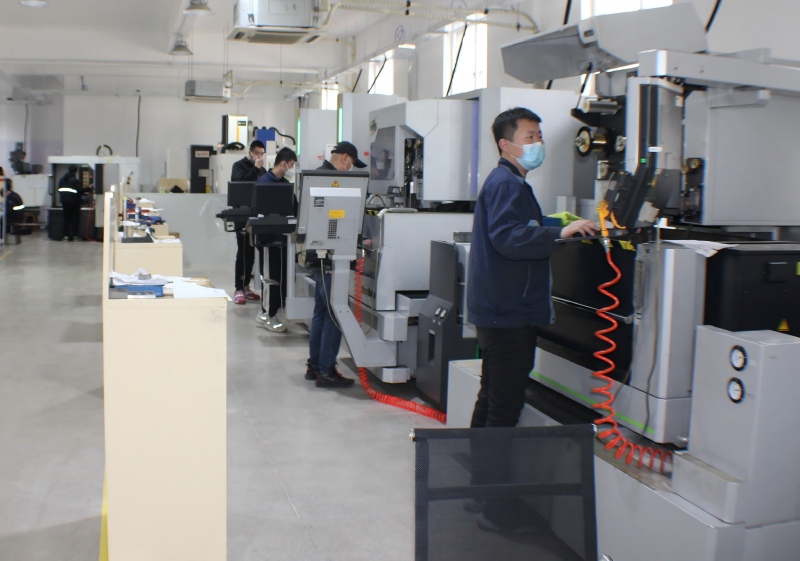
Cost Efficiency Through Scalable Processes
Scalability also plays a key role in cost control. Machining partners that invest in automation, optimized fixturing, and efficient production planning can achieve better economies of scale. These efficiencies often translate into more competitive pricing for customers as volumes increase.
Rather than constantly renegotiating costs or redesigning processes with new suppliers, customers benefit from stable pricing structures and improved cost predictability over time.
Reducing Supply Chain Risk
Relying on a machining partner that cannot scale introduces long-term risk. If a supplier reaches its capacity limits too early, customers may be forced to split orders across multiple vendors or rush to qualify new suppliers—both of which increase complexity and risk.
A scalable machining partner reduces this exposure by offering long-term support, even as project requirements grow. This is particularly important in industries such as aerospace, medical, automotive, and industrial equipment manufacturing, where consistency and traceability are essential.
A Strategic Partnership, Not Just a Supplier
Ultimately, scalability turns a machining vendor into a strategic manufacturing partner. It demonstrates commitment, long-term investment, and a customer-focused mindset. Partners who plan for growth, upgrade their capabilities, and build flexible systems are better positioned to support innovation and long-term collaboration.
For engineers and purchasing professionals alike, choosing a scalable machining partner means choosing stability, flexibility, and confidence—today and in the future.
Conclusion
Scalability is no longer optional in modern manufacturing. It is a critical factor that affects cost, quality, delivery, and risk management throughout the product lifecycle. By working with a machining partner that can scale efficiently and reliably, companies gain more than production capacity—they gain a partner capable of supporting sustainable growth.