

In modern manufacturing, tooling strategy directly affects cost, lead time, scalability, and product quality. Whether developing a new product or scaling up production, manufacturers often face a critical decision: should they invest in soft tooling or hard tooling?
Understanding the differences between these two approaches is essential for engineers, procurement teams, and product managers who aim to balance speed, flexibility, and long-term production efficiency.
What Is Soft Tooling?
Soft tooling refers to tooling solutions made from less durable materials or processes designed primarily for short production runs, prototyping, or low-volume manufacturing. These tools are typically manufactured from aluminum, mild steel, epoxy-based composites, or even produced using additive manufacturing methods.
The main advantage of soft tooling lies in its flexibility and lower upfront cost. Because materials are easier to machine and modify, design adjustments can be implemented quickly. This makes soft tooling ideal for product development stages where changes are frequent and production volumes are uncertain.
In industries such as robotics, consumer electronics, and early-stage aerospace prototyping, soft tooling enables rapid iteration without committing significant capital investment.
However, soft tooling generally has a shorter service life. Under high pressure, elevated temperatures, or long production cycles, it wears faster and may lose dimensional stability over time.
In the manufacturing landscape, soft tooling serves as a vital middle ground between initial concept prototyping and high-volume mass production. However, like any specialized process, it is not a universal solution. Understanding the nuanced pros and cons of soft tooling is essential for engineers to determine when this methodology will yield the best Return on Investment (ROI).
The Strategic Advantages of Soft Tooling
The primary strengths of soft tooling lie in its economic efficiency, rapid turnaround, and adaptability. For projects in the iterative design phase or those requiring limited production runs, soft tooling offers several key benefits:
Minimized Upfront Capital Expenditure
One of the most compelling reasons to choose soft tooling is the significant reduction in initial costs. By utilizing materials such as aluminum, silicone, or even specialized zinc alloys—which are far more affordable than the hardened tool steels required for permanent molds—manufacturers can drastically lower their barrier to entry. Furthermore, the fabrication process is less labor-intensive, requiring fewer hours of heavy-duty CNC machining, making it an ideal choice for startups and budget-conscious development.
Accelerated Market Entry
In competitive industries, the speed of development is a decisive factor. Soft tooling excels by shortening lead times from months to mere days. While traditional hard tooling requires extensive heat treatment and precision grinding, a soft tool can be ready for production almost immediately. This allows for rapid physical validation and a much faster transition from CAD to the end-user.
Enhanced Design Agility
Soft tooling provides a safety net for the iterative design process. If a batch of parts reveals a functional flaw or an opportunity for improvement, modifying a soft mold is both simple and cost-effective. Unlike the “set-in-stone” nature of hardened steel, soft materials allow for easy adjustments or the creation of a new tool without incurring crippling expenses.
The Perfect “Bridge” for Low-Volume Production
When production requirements fall between a dozen and a few hundred units, soft tooling is the most logical choice. It is frequently used as “bridge tooling”—a temporary solution that allows manufacturers to fulfill orders or conduct market testing while waiting for long-lead hard tools to be completed.
The Critical Disadvantages of Soft Tooling
Despite its flexibility, soft tooling carries inherent limitations that can impact the long-term viability and precision of a project.
Limited Tool Longevity
The most significant trade-off is durability. Because the mold materials are inherently softer, they succumb to wear and tear much faster than steel. For instance, a silicone mold may only maintain its dimensional integrity for 25 to 50 cycles before the geometry begins to degrade. This makes soft tooling completely impractical for sustained mass production
Material and Pressure Constraints
Soft molds are generally unable to withstand the extreme temperatures and high injection pressures required for certain high-performance engineering plastics. This limits the palette of materials available to the designer. Rigid or high-melt-point resins typically demand the structural integrity that only hard tooling can provide.
Tolerances and Surface Consistency
While excellent for functional prototypes, soft tooling often lacks the extreme precision of its hardened counterparts. Under the heat and pressure of the molding cycle, soft materials can experience minor deflection or warping. This can result in slightly looser tolerances and a surface finish that may not meet the mirror-polished standards required for high-end consumer aesthetics.
What Is Hard Tooling?
Hard tooling, in contrast, is designed for durability and long-term production. It is typically manufactured from hardened tool steel or other high-strength alloys capable of withstanding high loads, high temperatures, and repeated mechanical stress.
Hard tooling requires greater initial investment due to material cost, machining time, and often heat treatment processes. However, once completed, it supports high-volume production with consistent dimensional accuracy and minimal wear.
Automotive mass production, aerospace structural components, and large-scale industrial manufacturing frequently rely on hard tooling because of its reliability and repeatability over extended production cycles.
While less flexible for design changes, hard tooling excels in stability, longevity, and cost efficiency when amortized across large quantities.
The Advantages of Hard Tooling
Hard tooling is engineered for endurance, making it the preferred choice for projects that demand consistency across millions of cycles.
Superior Structural Durability
Hard tools are built to withstand the rigors of continuous operation. Fabricated from high-strength metals—typically heat-treated tool steels—these molds are resistant to the thermal and mechanical stresses of high-speed production. Unlike softer alternatives, they do not succumb easily to wear, ensuring a reliable production life that spans years.
Uncompromising Dimensional Accuracy
The rigidity of the materials used in hard tooling prevents warping or deflection under the intense pressure of injection molding. This inherent stiffness allows manufacturers to maintain incredibly tight and consistent tolerances. For industries where precision is non-negotiable, such as aerospace and medical device manufacturing, hard tooling is the only viable option.
Engineered for Massive Scaling
High-volume output is the primary driver for adopting hard tooling. These molds are designed to facilitate rapid cycle times and can be configured with multiple cavities, allowing for the simultaneous production of several parts in a single stroke. This capability dramatically accelerates the manufacturing timeline for mass-market products.
Long-Term Financial Efficiency
While the initial “sticker price” is high, a high-quality hard tool offers an excellent Return on Investment (ROI) over time. When the substantial upfront cost is amortized across a million or more units, the cost-per-part drops to a fraction of what it would be using other methods, making it the most economical choice for long-term manufacturing.
The Disadvantages of Hard Tooling
Despite its performance, hard tooling presents specific challenges regarding capital and flexibility that must be managed.
Significant Upfront Capital Expenditure (CapEx)
There is no denying that hard tooling is an expensive undertaking. The combination of high-grade raw materials and the complex, multi-stage CNC machining and EDM (Electrical Discharge Machining) processes creates a high barrier to entry. For startups or projects with limited liquid capital, this initial investment can be a major hurdle.
Extended Development Timelines
Quality cannot be rushed in hard tool fabrication. The process of designing, machining, heat-treating, and validating a hardened steel tool can take anywhere from several weeks to several months. This extended lead time can delay a product launch, making it less suitable for industries with rapidly shifting market trends.
Design Rigidity and Modification Costs
Once a steel tool has been hardened, it becomes extremely difficult to modify. Even a minor design tweak can necessitate expensive re-machining or, in the worst-case scenario, the total scrapping of the tool. Consequently, hard tooling is ill-suited for products still in the iterative or “alpha” stages of design where changes are frequent.
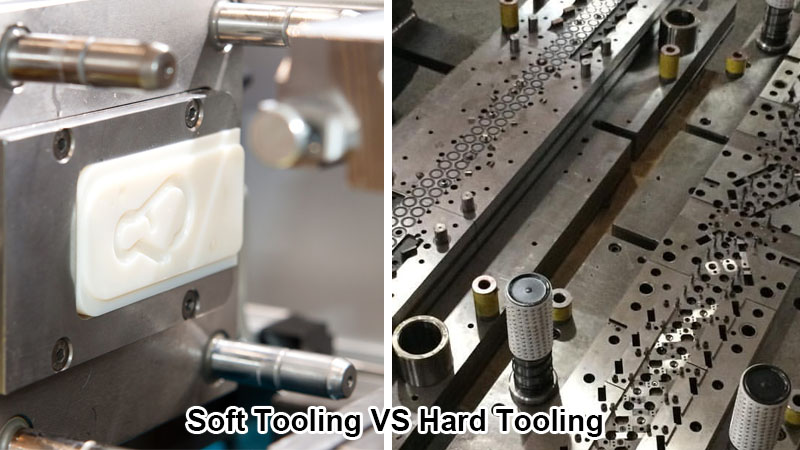
Key Differences between Soft tooling and Hard tooling
To make an informed manufacturing decision, it is essential to understand the fundamental distinctions between soft and hard tooling. Below is a comparison across four critical dimensions.
1. Tooling Materials
The choice of material is the most significant differentiator between the two methods:
Soft Tooling: Utilizes more pliable materials, including silicone, polyurethane, and aluminum.
Hard Tooling: Relies on robust, high-strength metals such as P20 tool steel, H13 steel, and various other hardened steel alloys.
The material choice directly dictates every other aspect of the project, including total lifespan and initial expenditure.
2. Tooling Applications
The intended use cases for these methodologies are vastly different:
Soft Tooling: Best suited for prototyping, design validation, and low-volume production. It is the standard for creating initial functional models through processes like urethane casting.
Hard Tooling: Specifically engineered for the high-speed, high-efficiency production of massive quantities. It is the industrial gold standard for injection molding medical devices, automotive components, and consumer electronics.
The “soft vs. hard” debate typically centers on the total part count required for the project life cycle.
3. Tooling Costs
Budget is often the deciding factor in tooling selection:
Soft Tooling: Features a low upfront cost, making it the ideal entry point for startups or small-batch runs where minimizing initial risk is a priority.
Hard Tooling: Requires a significant initial investment. However, because of its extreme durability, the cost-per-part becomes significantly lower as volume increases, making it much more cost-effective for mass production in the long run.
4. Production Efficiency
The definition of “speed” depends entirely on your output requirements:
Soft Tooling: Superior for short-term agility. Because the lead times for mold fabrication are very short, it is the best option for getting a small number of parts into your hands quickly.
Hard Tooling: Superior for scaled manufacturing. It is the undisputed choice for mass production due to its ability to run at high cycle speeds and utilize multi-cavity molds to produce multiple parts simultaneously.
Conclusion
Soft tooling and hard tooling serve different but equally important roles in modern manufacturing. Soft tooling supports flexibility, speed, and lower financial risk during early production stages. Hard tooling delivers durability, precision stability, and cost efficiency for long-term, high-volume manufacturing.
The right choice depends on production goals, expected volume, budget, and product maturity. By evaluating these factors carefully, manufacturers can optimize both short-term development efficiency and long-term operational performance.