

Aluminum alloys are among the most widely used materials in aerospace and robotics due to their combination of light weight, strength, and corrosion resistance. Within the aluminum family, 6061 and 7075 alloys stand out as two of the most popular options. Choosing the right alloy can mean the difference between optimal performance and costly design compromises. This guide explores the key differences between 6061 and 7075 aluminum, their mechanical properties, machinability, and best-fit applications in aerospace and robotics.
Overview of Aluminum 6061 and 7075
Aluminum 6061 is part of the 6000 series, which combines aluminum with magnesium and silicon. It is renowned for its versatility, excellent corrosion resistance, and ease of machining. 6061 provides a good balance of strength and ductility, making it suitable for components that require moderate mechanical performance with consistent reliability. Its natural anodizing capability further enhances corrosion protection, which is particularly useful in outdoor or harsh environments.
Aluminum 7075, on the other hand, belongs to the 7000 series and is alloyed primarily with zinc, along with small amounts of magnesium and copper. This alloy is known for its exceptionally high strength, comparable to many steels, while still maintaining the light weight that aluminum offers. 7075’s superior mechanical properties come at a cost: it is more challenging to machine and has slightly reduced corrosion resistance compared to 6061. However, heat treatment processes can further enhance its performance, making it a top choice for high-stress aerospace components.
Mechanical Properties Comparison
When selecting between 6061 and 7075, understanding their mechanical differences is crucial:
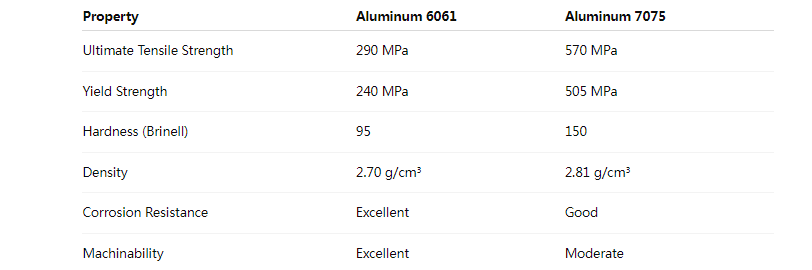
6061 offers moderate strength but excels in corrosion resistance and ease of fabrication. 7075 provides near-double the strength of 6061, which is essential for load-bearing or high-stress applications, particularly in aerospace structures or precision robotics where every gram counts but structural integrity is critical.
Machinability and Fabrication Considerations
6061 aluminum is easier to machine, bend, and weld compared to 7075. It can achieve smooth surface finishes and precise tolerances without extensive tooling or specialized machining parameters. Its workability makes it ideal for prototypes, robotic chassis components, and medium-load aerospace parts.
7075 aluminum, while extremely strong, is more prone to tool wear and requires higher-quality cutting tools and careful speed-feed control during machining. Its relative hardness and tendency to crack under improper conditions mean that deep cuts, thin walls, or high-speed drilling must be approached with caution. In return, 7075 allows designers to achieve ultra-lightweight structures with very high strength-to-weight ratios—a key requirement for aerospace wings, fuselage reinforcements, or robotic arms subjected to heavy loads.
Corrosion Resistance and Environmental Considerations
6061 is naturally more corrosion-resistant, which makes it suitable for marine, outdoor, or humid environments. Anodizing 6061 not only improves corrosion protection but also allows for color-coding components for assembly or aesthetic purposes. This can be especially helpful in robotics projects where visual identification of parts speeds up maintenance and assembly.
7075, while inherently less resistant to corrosion due to its high zinc content, can still be treated via anodizing or protective coatings. Engineers typically select 7075 when mechanical strength is paramount and environmental exposure is moderate or controlled.
Conclusion
Both Aluminum 6061 and 7075 are indispensable materials in aerospace and robotics, but their differences make them suitable for distinct applications. 6061 excels in corrosion resistance, machinability, and versatility, making it ideal for moderate-load structures and components exposed to harsh environments. 7075, with its exceptional strength and stiffness, is best suited for critical structural components where weight reduction is essential, and higher machining effort is acceptable.
Selecting the right alloy is a balance between mechanical requirements, environmental conditions, and fabrication capabilities. Understanding these distinctions ensures engineers can optimize performance, extend component life, and streamline the development of high-precision aerospace and robotic systems.
Frequently Asked Questions (FAQ)
Q1: Can I replace Aluminum 6061 with 7075 to make my part stronger without changing the design?
A: In most cases, yes, the part will be significantly stronger. However, you must consider the joining method. If your original 6061 design relied on welding, you cannot simply swap to 7075 because 7075 is generally non-weldable. You would need to redesign the assembly using mechanical fasteners or specialized adhesives.
Q2: Which alloy is better for parts that require a high-quality aesthetic finish?
A: Aluminum 6061 is the winner here. Due to its lower alloying content, it accepts anodizing dyes more consistently, resulting in a vibrant, uniform finish. While 7075 can be anodized, its high zinc and copper content can sometimes lead to a slightly “muddier” or darker appearance, especially with lighter colors.
Q3: Is Aluminum 7075 worth the extra cost for a ground-based robot?
A: It depends on the robot’s function. For a heavy industrial AGV where weight isn’t a primary concern, 6061 is more cost-effective. However, for a high-speed robotic arm or a jumping robot, the superior strength-to-weight ratio of 7075 is worth every penny, as it reduces the “moving mass” and allows for faster acceleration.
Q4: How does the “T6” temper affect these two alloys during CNC machining?
A: The “T6” temper indicates that both alloys have been solution heat-treated and artificially aged. In the machine shop, T6 makes both alloys much easier to machine than in their “O” (annealed) state. 6061-T6 offers a good balance of speed and tool life, while 7075-T6 is more brittle, which actually helps in producing clean, breakable chips—though it will wear down your cutting tools faster.
Q5: Does 7075 Aluminum rust?
A: “Rust” technically only applies to iron-based metals, but 7075 is highly susceptible to corrosion. Because of its high copper content, it can develop pits and structural weaknesses if exposed to moisture or salt spray without a protective coating (like anodizing or painting). For high-humidity environments, 6061 offers better natural protection.