
Surface grinding is a precision machining process used to produce flat, smooth, and accurately controlled surfaces on metal and other suitable materials. Unlike milling, which removes material primarily through cutting edges on a rotating tool, surface grinding uses an abrasive grinding wheel to remove a small amount of material from the workpiece.
Surface grinding is widely used when a component requires tight dimensional tolerances, good flatness, parallelism, or a controlled surface finish. It is particularly valuable as a finishing operation after processes such as CNC milling, turning, heat treatment, or other forms of rough machining.
For precision-machined components, surface grinding can provide a level of dimensional and surface control that may be difficult to achieve through conventional machining alone.
What Is Surface Grinding?
Surface grinding is a machining process in which a rotating abrasive wheel removes material from the surface of a workpiece.
The workpiece is normally secured on a grinding machine, often using a magnetic chuck when machining suitable ferromagnetic materials. The grinding wheel then travels across the workpiece surface while removing a very small amount of material with each pass.
Surface grinding is generally considered a finishing process because the amount of material removed during each pass is relatively small compared with rough milling or other high-material-removal operations.
How Does Surface Grinding Work?
A grinding wheel contains many abrasive grains. Each grain acts as a very small cutting edge. As the wheel rotates at high speed and comes into contact with the workpiece, the abrasive grains remove small amounts of material from the surface.
The workpiece and grinding wheel move relative to each other according to the selected grinding method.
A typical surface grinding operation may involve:
**Workpiece setup → Grinding wheel selection → Wheel dressing → Rough grinding → Finishing passes → Inspection**
The actual process depends on the material, required tolerance, surface finish, workpiece geometry, and machine configuration.
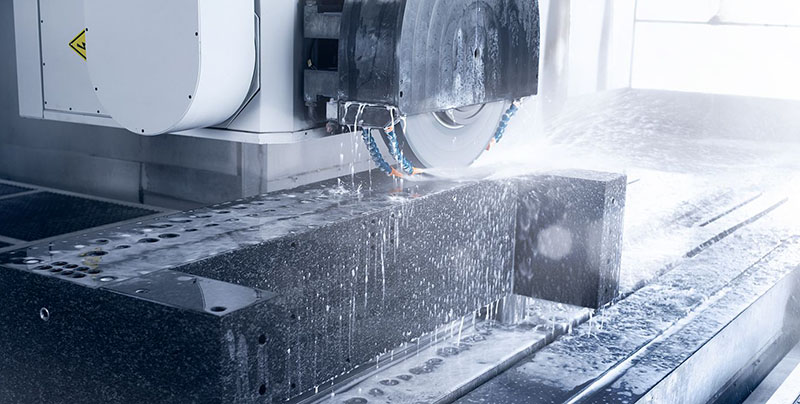
Common Types of Surface Grinding
Surface grinding can be performed using different machine configurations and grinding-wheel arrangements.
Horizontal-Spindle Surface Grinding
Horizontal-spindle grinding is one of the most common surface grinding configurations.
The grinding wheel rotates around a horizontal spindle, and the workpiece is moved across the table beneath the wheel.
The peripheral surface of the grinding wheel performs most of the cutting.
This configuration is commonly used for precision grinding of flat surfaces and is suitable for a wide range of industrial components.
Vertical-Spindle Surface Grinding
In vertical-spindle grinding, the grinding wheel rotates around a vertical spindle.
The face of the grinding wheel contacts the workpiece surface.
This configuration can provide a relatively large contact area and can be useful for removing material from larger surfaces or for certain high-productivity grinding operations.
The choice between horizontal- and vertical-spindle grinding depends on the workpiece geometry, required accuracy, material, wheel characteristics, and production requirements.
Single-Pass and Reciprocating Grinding
The workpiece can also be processed using different table-motion strategies.
In reciprocating grinding, the table moves back and forth beneath the grinding wheel while the wheel gradually traverses across the workpiece.
For certain applications, deeper or more controlled grinding passes may be used depending on the machine and material.
The grinding strategy should be selected according to the required material removal, accuracy, surface finish, and production efficiency.
How Accurate Is Surface Grinding?
Surface grinding is capable of achieving high dimensional accuracy, but the actual achievable tolerance depends on many factors.
These include:
- Machine condition and rigidity
- Grinding wheel selection
- Wheel dressing
- Workpiece material
- Workholding method
- Grinding parameters
- Thermal stability
- Operator and process control
- Inspection equipment
Under controlled conditions, surface grinding can achieve very tight dimensional tolerances and excellent flatness.
However, it is important not to assume that every surface grinding operation automatically provides micron-level accuracy.
For precision components, the achievable tolerance should be evaluated based on the specific machine, material, geometry, and process conditions.
Surface Grinding and Flatness
Flatness is one of the most important reasons manufacturers use surface grinding.
A milled surface may meet its dimensional requirement while still having localized variations in flatness caused by tool deflection, machine behavior, workholding, material stress, or other factors.
Surface grinding can provide a more controlled reference surface.
This is particularly useful for components that must be assembled against another precision surface.
When two components must maintain close contact, a controlled flat surface can be critical to assembly accuracy.
Surface Grinding and Parallelism
Surface grinding can also be used to control the relationship between two opposing surfaces.
For example, a component may require its top and bottom surfaces to remain parallel within a specified tolerance.
Grinding one surface and then using it as a reference for grinding the opposite surface can help establish controlled thickness and parallelism.
This is especially important for precision plates, spacers, blocks, and components that must maintain a consistent thickness.
Surface Finish After Grinding
Surface grinding can produce a much finer and more uniform finish than many conventional rough-machining operations.
The final surface roughness depends on factors such as abrasive grain size, wheel condition, grinding parameters, coolant, material, and dressing conditions.
A finer grinding wheel generally allows a finer surface finish, but wheel selection must also consider material behavior and grinding efficiency.
The required surface finish should therefore be specified according to the functional requirements of the component rather than simply selecting the lowest possible Ra value.
Surface Grinding vs CNC Milling
Surface grinding and CNC milling can both produce flat surfaces, but they are used for different purposes.
CNC milling is generally more suitable for material removal and for creating complex geometries such as pockets, slots, holes, steps, and contours.
Surface grinding is generally used when the priority is highly controlled surface geometry, dimensional accuracy, flatness, parallelism, or surface finish.
A component may therefore be CNC milled first and surface ground afterward.
For example, a precision aluminum or steel plate may be rough-machined using CNC milling to achieve its basic dimensions and features. Critical surfaces can then undergo grinding to achieve the required thickness, flatness, or finish.
The two processes are complementary rather than interchangeable.
What Materials Can Be Surface Ground?
Surface grinding is widely associated with steel and other ferrous metals, but the process can also be used for a broader range of materials when appropriate equipment, abrasives, and parameters are selected.
Common materials include:
Hardened Steel
Surface grinding is particularly valuable after heat treatment because hardened steel can be difficult to machine efficiently using conventional cutting tools.
Grinding can restore critical dimensions after heat treatment and produce precise finished surfaces.
Tool Steel
Tool steels used for molds, dies, fixtures, and tooling components are frequently ground to achieve accurate dimensions and controlled surface finishes.
Stainless Steel
Stainless steel can be surface ground, but it requires appropriate wheel selection and process control because some grades can generate significant heat or cause wheel loading.
Coolant management and grinding parameters are important when grinding stainless steel.
Aluminum
Aluminum can also be ground, although its relatively soft and ductile nature can cause abrasive loading if unsuitable wheels or parameters are used.
The grinding process must therefore be selected carefully to avoid wheel loading and surface defects.
Carbide and Other Hard Materials
Very hard materials may require specialized abrasives such as diamond or CBN.
The specific grinding process depends heavily on the material’s hardness, toughness, thermal properties, and application requirements.
Why Is Coolant Important in Surface Grinding?
Grinding generates heat because many abrasive grains interact with the workpiece simultaneously.
If heat is not controlled, several problems can occur, including thermal distortion, changes in material properties, grinding burn, and dimensional instability.
Coolant can help control grinding temperature, flush away chips and abrasive debris, and improve the stability of the grinding process.
The appropriate coolant and delivery method depend on the machine, grinding wheel, workpiece material, and application.
For precision grinding, thermal management becomes especially important because even small temperature changes can affect dimensional measurements.
Common Surface Grinding Problems
Several defects can occur when the grinding process is not properly controlled.
Grinding Burn
Grinding burn is associated with excessive heat generation at the workpiece surface.
It can result from inappropriate grinding parameters, a loaded or improperly dressed wheel, inadequate coolant, or excessive grinding pressure.
For components that have undergone heat treatment, thermal damage can be particularly undesirable because it may affect surface properties.
Chatter and Vibration
Grinding vibration can create visible patterns or irregularities on the workpiece surface.
Possible causes include machine vibration, poor workholding, wheel imbalance, inappropriate parameters, or mechanical problems.
Stable machine conditions and proper wheel balancing and dressing are important for minimizing vibration.
Uneven Surface Finish
An inconsistent surface finish may result from uneven wheel wear, incorrect dressing, unstable coolant flow, or unsuitable grinding parameters.
Regular process monitoring can help identify these problems before they affect a large number of components.
When Should You Use Surface Grinding?
Surface grinding is particularly useful when a component requires a combination of dimensional accuracy and controlled surface geometry.
Typical applications include:
Precision tooling: Fixture plates, tooling components, dies, molds, and gauges often require accurately controlled flat surfaces.
Machine components: Precision machine parts may require flat mounting surfaces or controlled thickness.
Automotive components: Certain precision components and tooling can require grinding after machining or heat treatment.
Aerospace components: Components with demanding dimensional and surface requirements may use grinding as part of the finishing process.
Automation equipment: Precision mounting plates, mechanical interfaces, and custom machine components can benefit from controlled flatness and parallelism.
General CNC components: Grinding can be used as a secondary process when milling or turning alone cannot achieve the required specifications.
How to Specify Surface Grinding on a Drawing
When surface grinding is required, the engineering drawing should clearly define the critical requirements.
Depending on the component, this may include:
- Final dimensions
- Dimensional tolerances
- Flatness
- Parallelism
- Perpendicularity
- Surface roughness
- Material grade
- Heat-treatment condition
- Grinding area
- Edge and burr requirements
For example, simply specifying “surface grind” does not tell the manufacturer exactly what final accuracy or surface condition is required.
Clear technical specifications help the manufacturer select an appropriate process and avoid unnecessary finishing costs.
Conclusion
Surface grinding is a precision finishing process used to produce accurate, flat, and smooth surfaces on machined components.
By using a rotating abrasive wheel under controlled conditions, manufacturers can achieve tight dimensional control, excellent flatness, parallelism, and controlled surface roughness.
The process is particularly valuable for hardened steels, tooling components, precision plates, machine components, and other parts where conventional milling or turning cannot provide the required final surface condition.
However, surface grinding is not simply a matter of running a grinding wheel over a component. Wheel selection, dressing, workholding, grinding parameters, coolant, thermal control, and inspection all influence the final result.
For precision CNC machining, surface grinding is best viewed as a complementary finishing process. CNC milling and turning establish the basic geometry and features, while surface grinding can provide the final level of dimensional and surface control required for demanding applications.