


Aluminum is widely used in CNC machining due to its excellent machinability, lightweight nature, and favorable strength-to-weight ratio. However, while aluminum performs well structurally, untreated aluminum surfaces are often not sufficient for long-term use in demanding environments. This is where anodizing becomes a critical finishing process.
An anodized finish does more than improve appearance. It enhances durability, protects functional surfaces, and improves the overall performance of aluminum parts in real-world applications. For many machined aluminum components, anodizing is not an optional cosmetic step—it is a functional requirement.
Understanding the Anodizing Process
Anodizing is an electrochemical process that converts the outer surface of aluminum into a controlled aluminum oxide layer. Unlike paint or plating, this oxide layer becomes an integral part of the material rather than a coating applied on top.
The anodized layer grows both inward and outward from the original surface, creating a hard, dense structure that significantly improves surface characteristics without compromising dimensional stability. The thickness and properties of this layer can be precisely controlled depending on the application requirements.
Improved Corrosion Resistance
One of the primary reasons aluminum parts are anodized is corrosion protection. Bare aluminum naturally forms a thin oxide layer, but this layer is often uneven and insufficient in harsh environments.
Anodizing creates a uniform, sealed oxide layer that protects aluminum from moisture, chemicals, and atmospheric exposure. This is particularly important for parts used outdoors, in humid conditions, or in contact with coolants, lubricants, or cleaning agents.
For machined components expected to maintain performance over long service cycles, anodizing significantly extends part life and reduces maintenance requirements.
Increased Surface Hardness and Wear Resistance
Machined aluminum surfaces are relatively soft and prone to scratching, galling, and wear—especially in applications involving sliding contact or repeated handling.
Anodized aluminum surfaces are substantially harder than raw aluminum. This increased hardness improves wear resistance and helps maintain dimensional integrity over time. In assemblies where aluminum parts interface with other components, anodizing reduces surface damage and improves long-term reliability.
Hard anodizing, in particular, is commonly specified for functional components such as housings, brackets, and wear surfaces where durability is critical.
Better Performance in Mechanical Assemblies
Surface condition plays a critical role in how machined parts behave in assemblies. Untreated aluminum may experience fretting, material transfer, or surface deformation under load.
An anodized finish provides a stable, controlled surface that improves performance in mechanical interfaces. It reduces the risk of surface galling and helps maintain consistent fit and alignment during assembly and operation.
For precision machined parts with tight tolerances, a controlled anodized layer ensures predictable surface behavior without introducing uncontrolled variation.
Electrical and Thermal Properties
Anodizing also alters the electrical properties of aluminum surfaces. The oxide layer is electrically insulating, which is beneficial in many electronic and electrical applications.
This makes anodized aluminum suitable for housings, enclosures, and structural components where electrical isolation is required without adding separate insulating materials. At the same time, anodized aluminum retains much of its thermal conductivity, making it useful in applications where heat dissipation is still necessary.
Understanding these properties early in the design phase helps engineers specify anodizing correctly and avoid unintended functional issues.
Enhanced Surface Appearance and Identification
While performance is the primary reason for anodizing in machining applications, appearance also matters—especially for customer-facing or visible components.
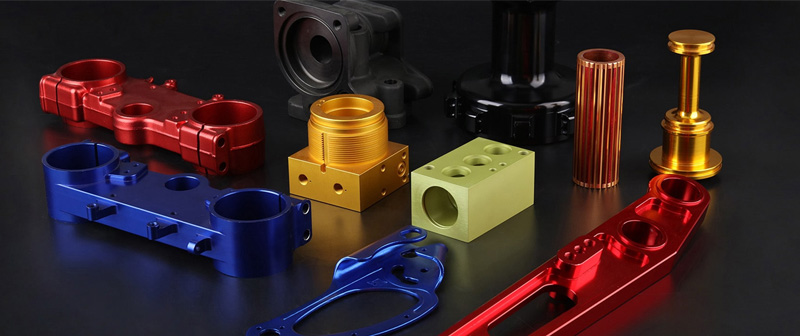
Anodizing provides a uniform, professional finish that enhances surface consistency. It also allows for color options without compromising surface durability. Unlike painted surfaces, anodized colors do not peel or flake, making them suitable for long-term use.
For many consumer-facing products, look and feel are just as important as function.
Vibrant Dyes: The anodic layer is porous before it is sealed, allowing it to absorb vibrant dyes. You can achieve almost any color, from metallic reds and blues to deep blacks.
Metallic Lustre: Unlike paint, which masks the texture of the metal, anodizing preserves the metallic sheen and the high-quality look of the CNC-machined surface.
Compatibility With Precision Machining
Anodizing is highly compatible with CNC-machined aluminum parts, provided it is considered during the design and machining stages. Because anodizing adds a measurable layer thickness, tolerances must account for material growth.
Experienced machining suppliers understand how to machine parts with anodizing in mind—adjusting dimensions and surface finishes so that final anodized components meet specification. When properly planned, anodizing enhances part performance without compromising precision.
Reduced Maintenance and Longer Service Life
Anodized aluminum parts are easier to clean and maintain than untreated aluminum. The sealed oxide surface resists staining, corrosion, and surface degradation, making it suitable for industrial environments where cleanliness and reliability matter.
This reduced maintenance requirement lowers long-term operating costs and improves equipment uptime, particularly in automated systems or hard-to-access installations.
A Critical Note for Engineers: Managing Dimensional Tolerances
One of the most important aspects of anodizing to understand during the design phase is how it affects the final dimensions of your part. Unlike plating, which only adds material to the surface, anodizing is a conversion process.
The 50/50 Rule As the anodic layer grows, it penetrates the base metal and builds up on the surface simultaneously. Generally, about 50% of the coating thickness is penetration and 50% is growth above the original surface.
- Impact on Diameters:If you specify a coating thickness of 0.02mm per side, the total diameter of a shaft will increase by 0.02mm, while the diameter of a hole will decrease by 0.02mm.
- Type II vs. Type III:* Type II is typically thin (0.005mm to 0.025mm). For most general-purpose parts, this change is negligible.
Type III (Hardcoat) is much thicker (0.025mm to 0.1mm). This will significantly impact high-precision fits, such as bearing seats or threaded holes.
Pro-Tip for Success: Always specify on your technical drawings whether dimensions apply “Before Anodize” or “After Anodize.” For extremely tight tolerances (like H7 fits), we recommend masking those specific areas to keep them at the raw-machined dimension.
Conclusion
An anodized finish transforms machined aluminum parts from basic components into durable, high-performance solutions. By improving corrosion resistance, surface hardness, mechanical reliability, and appearance, anodizing addresses many of the inherent limitations of untreated aluminum.
For CNC-machined aluminum parts intended for real-world use, anodizing is a practical and often essential finishing process. When incorporated into the design and machining strategy from the beginning, it enhances both part performance and long-term value.