


In modern manufacturing, material selection plays a decisive role in product performance, cost efficiency, and long-term durability. Among the most commonly used polymers, HDPE (High-Density Polyethylene) and PET (Polyethylene Terephthalate) stand out as two versatile materials that serve a wide range of applications across packaging, consumer products, industrial components, and CNC-machined plastic parts. Although both belong to the broader family of thermoplastics, their mechanical behavior, chemical properties, and processing characteristics differ significantly. Understanding these differences helps engineers, product designers, and manufacturers choose the most suitable material for their specific needs.
HDPE: A Highly Durable and Impact-Resistant Polymer
HDPE is known for its exceptional toughness, high impact strength, and excellent chemical resistance. Its molecular structure—characterized by minimal branching—creates a dense, highly crystalline polymer, giving HDPE its robust mechanical properties. This makes it ideal for heavy-duty applications such as fluid tanks, outdoor containers, piping systems, machined structural components, and industrial fittings.
Manufacturers value HDPE for its ease of processing and machinability. It cuts cleanly, maintains dimensional stability under load, and resists water absorption, which is critical for applications exposed to moisture or variable environments. Its low friction coefficient also makes it useful for wear-resistant parts such as gears, slides, and bearings used in automated machinery. While HDPE does not offer high temperature resistance or rigidity compared to engineering plastics like nylon or POM, its balance of strength, cost-effectiveness, and durability makes it indispensable in many production environments.
Key Characteristics of HDPE
Durability and Impact Resistance: HDPE is naturally flexible, which allows it to absorb impacts without cracking. This makes it perfect for parts like bumpers or protective guards that might get hit.
Chemical Resistance: It stands up very well against many acids, bases, and solvents. This is why it’s used for chemical drums and tank liners.
Low Moisture Absorption: HDPE barely absorbs any water, so it won’t swell or lose its properties in wet environments, making it great for outdoor use.
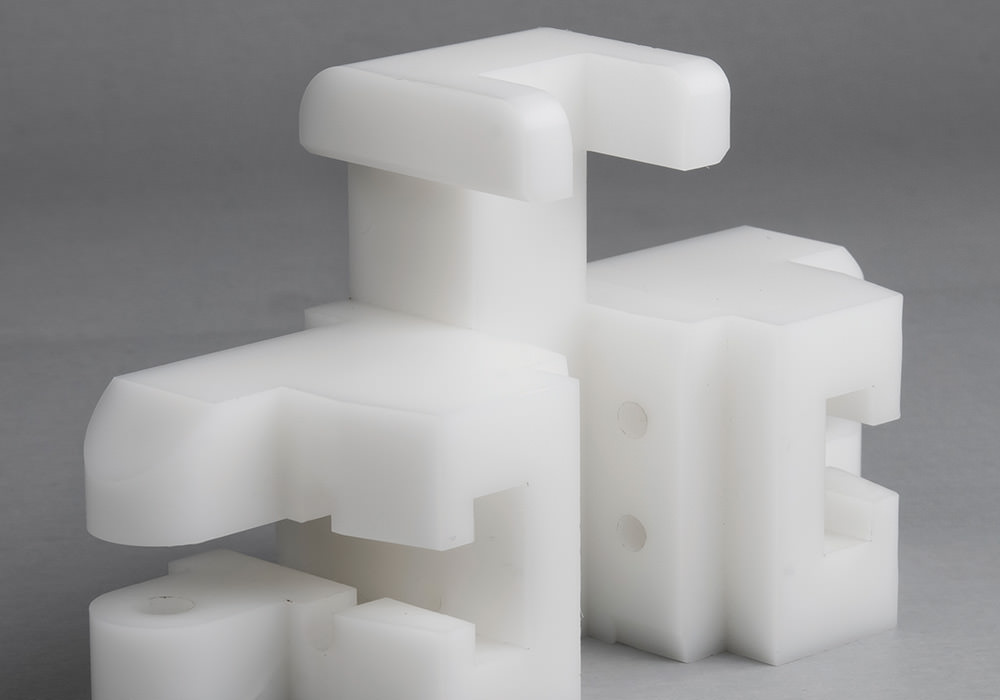
PET: A Strong, Rigid, and Dimensionally Stable Material
PET is a high-performance thermoplastic polyester characterized by superior rigidity, tensile strength, and dimensional stability. Unlike HDPE’s softer and more flexible structure, PET is much stiffer, offering excellent resistance to deformation under mechanical or thermal loads. PET also has outstanding transparency in its amorphous form, making it a popular material for bottles and clear packaging, while its semi-crystalline grades are widely used for industrial parts.
In engineering applications, PET provides excellent wear resistance, low creep, high hardness, and a smooth surface finish, making it particularly suitable for CNC machining when tight tolerances are required. PET components can maintain accuracy even under high load or continuous mechanical stress. Additionally, PET’s low permeability to gases and aromas makes it ideal for food and beverage packaging. Its thermal stability exceeds that of HDPE, allowing PET parts to perform better in higher-temperature environments.
Key Characteristics of PET
Clarity and Gloss: PET is naturally transparent and can be polished to a high gloss, making it ideal for see-through parts or housings.
Strength and Rigidity: It has excellent tensile strength and stiffness, so it won’t bend or stretch easily under stress. This is key for making structural brackets or supports.
Dimensional Stability: PET is not significantly affected by temperature or humidity, so parts made from it will hold their precise dimensions over time.
Comparing Mechanical and Chemical Performance
When evaluating HDPE and PET in manufacturing, the two materials occupy different performance niches. HDPE excels in applications requiring impact resistance, flexibility, and chemical durability. It is unaffected by water, detergents, mild acids, and many solvents, making it attractive for outdoor products and industrial storage solutions. PET, however, offers superior rigidity and strength, making it ideal for components that must retain shape and dimensional integrity under mechanical stress.
PET outperforms HDPE in heat resistance, maintaining structural properties at significantly higher temperatures. In contrast, HDPE softens easily and has limited temperature capability, which restricts its use in high-heat environments. Conversely, HDPE provides better low-temperature impact performance, maintaining toughness even in sub-zero conditions.
Manufacturing and Machining Considerations
From a processing perspective, both materials are easy to mold and extrude, but their characteristics lead to distinct advantages depending on the application. HDPE’s lower density and softer structure make it easier to machine for large, thick-walled components without risk of brittleness. PET, on the other hand, supports precise CNC machining, providing tight tolerances and stable surface finishes ideal for precision gears, insulators, and mechanical housings.
Recyclability is also a major factor. PET is among the most heavily recycled plastics worldwide, particularly in the packaging industry, due to well-established recycling streams. HDPE is also widely recycled, especially in industrial and consumer product manufacturing, but PET enjoys broader acceptance in global recycling markets.
Choosing the Right Material: Application-Based Perspective
Manufacturers select between HDPE and PET based on the functional demands of the final product. HDPE is the optimal choice for items requiring flexibility, impact strength, and chemical resistance—such as drums, tanks, piping, outdoor equipment, and wear-resistant mechanical parts. PET is preferred for applications demanding rigidity, tight tolerances, thermal resistance, and structural stability, including precision components, beverage containers, mechanical gears, and electrical housings.
In many cases, the selection process depends on finding the right balance between durability, cost, manufacturability, environmental exposure, and aesthetic requirements. Both materials have earned a strong position in modern manufacturing due to their adaptability and performance, but choosing the correct one ensures optimal product longevity and quality.