
Brass is widely used in precision manufacturing because it combines good machinability, dimensional stability, corrosion resistance, electrical conductivity, and an attractive surface appearance. These characteristics make brass CNC machining a practical solution for producing precision components used in industrial equipment, electrical systems, automation, plumbing, and many other applications.
Compared with harder engineering metals, brass can generally be machined efficiently with relatively low cutting forces. However, achieving consistent dimensional accuracy and a high-quality surface finish still requires proper material selection, cutting parameters, tooling, workholding, and process control.
This article explains the key factors that affect the accuracy and surface finish of CNC machined brass parts and reviews their common industrial applications.
Why Is Brass Suitable for CNC Machining?
One of the main advantages of brass is its excellent machinability. Many brass alloys can be cut efficiently using turning, milling, drilling, tapping, and other CNC machining processes.
Brass generally produces relatively manageable cutting forces, allowing manufacturers to achieve good productivity without placing excessive loads on the machine tool. Its machinability also makes it suitable for parts with small holes, threads, slots, grooves, and other detailed features.
Another advantage is its dimensional stability. When the appropriate brass grade and machining conditions are selected, CNC machines can produce parts with consistent dimensions across repeated production runs.
Brass also offers good corrosion resistance and electrical conductivity. These properties are particularly useful for components that need both mechanical functionality and reliable electrical performance.
However, not all brass alloys behave in exactly the same way during machining. Leaded free-cutting brass, for example, can offer excellent machinability, while other brass grades may be selected primarily for strength, corrosion resistance, or electrical properties. Therefore, the material grade should always be specified according to the actual application.
How CNC Machining Affects the Accuracy of Brass Parts
The accuracy of a CNC machined brass component depends on much more than the positioning accuracy of the machine. Tool condition, workholding, material properties, thermal effects, cutting parameters, and machining sequence can all influence the final dimensions.
Machine and Tool Accuracy
A rigid and properly maintained CNC machine is essential when manufacturing precision brass components. Spindle runout, axis positioning errors, worn guideways, and poor machine calibration can affect dimensional consistency.
Cutting tools must also be sharp and suitable for brass. A worn tool can increase cutting forces and generate more heat, potentially causing dimensional variation and poor surface quality.
Tool runout is particularly important when machining small holes or precision features. Excessive runout can produce oversized holes, uneven cutting, and inconsistent tool wear.
Cutting Parameters
Spindle speed, feed rate, and depth of cut must be selected according to the brass alloy, tool geometry, feature size, and machining operation.
Brass generally allows relatively high cutting speeds, but simply increasing the speed does not automatically improve productivity or surface finish. Excessive cutting speed can increase heat generation and tool wear, while an inappropriate feed rate may produce visible tool marks or poor dimensional control.
For precision components, machining parameters should be optimized rather than selected solely according to general-purpose cutting charts.
Workholding and Part Stability
The workpiece must remain stable throughout machining. Although brass is relatively easy to cut, thin walls, small sections, and delicate features can deform under excessive clamping force or cutting pressure.
Proper fixture design helps maintain the position of the part and provides consistent support during machining. For thin-walled or complex brass components, the clamping method may be just as important as the cutting parameters.
Machining Sequence
The order in which features are machined can also influence accuracy.
For example, rough machining can remove a significant amount of material and release internal stresses. If a part requires tight dimensional tolerances, manufacturers may use a roughing operation followed by semi-finishing and finishing passes.
Critical dimensions may be machined later in the process after unnecessary material has been removed and the part has reached a more stable condition.
Achieving a High-Quality Surface Finish on Brass Parts
Brass can produce a naturally attractive machined surface, but the final finish depends heavily on tooling and machining conditions.
A sharp cutting edge, suitable tool geometry, stable workholding, and properly optimized feed rate can help produce a clean and consistent surface.
Tool marks can become more noticeable when machining large flat surfaces or cylindrical features. In these cases, finishing passes with controlled cutting parameters can significantly improve the appearance and surface roughness of the component.
Chip evacuation is another important factor. Accumulated chips can interfere with the cutting process, scratch the machined surface, or cause chips to be recut. Effective chip evacuation helps maintain a more consistent surface finish.
For applications requiring a specific surface roughness, the required Ra value should be clearly specified on the engineering drawing. The manufacturer can then select an appropriate machining and finishing strategy.
Surface Finishing Options for CNC Brass Parts
CNC machining can provide a functional surface finish without additional treatment, but some applications require further surface processing for appearance, corrosion resistance, wear resistance, or specific functional requirements.
Depending on the brass grade and application, common finishing options may include polishing, brushing, plating, coating, and other surface treatments.
Polishing can improve the visual appearance and smoothness of brass components, making it useful for decorative or exposed parts. Plating can provide additional surface properties and may also be used to achieve a particular appearance.
The surface treatment should be selected together with the brass material and dimensional requirements. Some finishing processes can add material to the surface or remove a small amount of material, which may affect tight tolerances.
For precision components, the manufacturer should therefore consider the final surface treatment during the machining stage rather than treating it as a completely separate process.
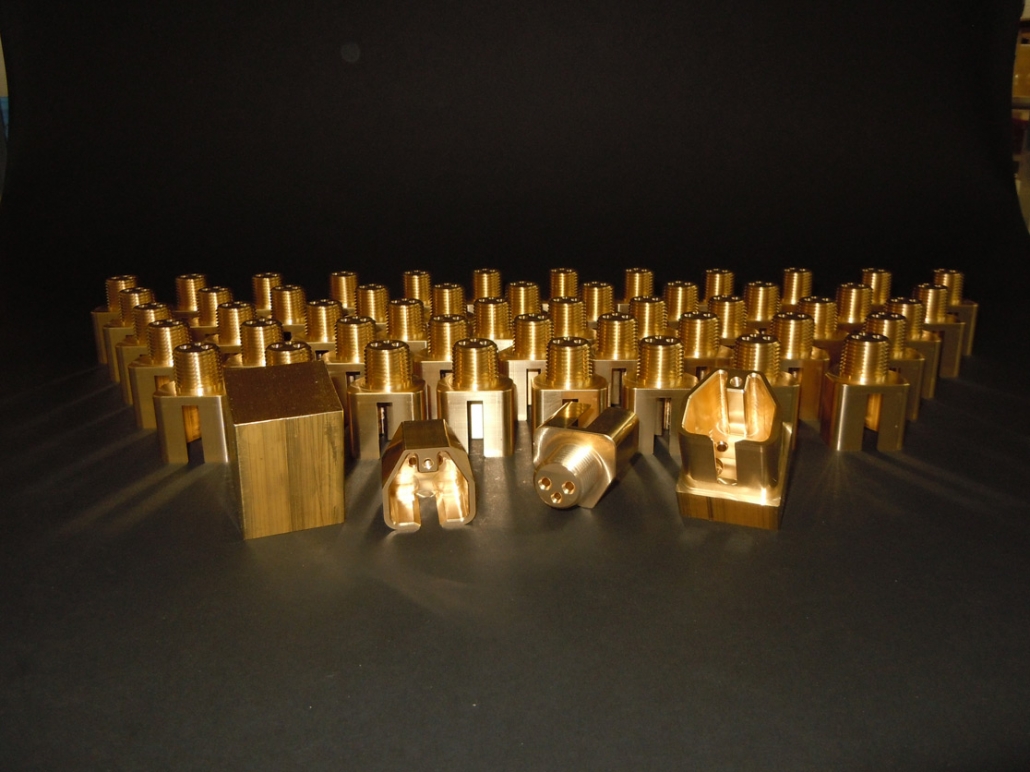
Common CNC Machining Processes for Brass Parts
Brass is compatible with most common CNC machining processes.
CNC Turning
CNC turning is widely used for producing cylindrical brass components such as bushings, spacers, shafts, fittings, connectors, and threaded components.
Because brass generally machines efficiently, turning can achieve high production rates while maintaining good dimensional consistency.
CNC Milling
CNC milling is suitable for brass components with flat surfaces, pockets, slots, holes, contours, and complex geometries.
Three-axis, four-axis, and five-axis machining can be selected according to the complexity and accessibility of the required features.
CNC Drilling and Tapping
Brass is also well suited to drilling and tapping operations. These processes are commonly used to create mounting holes, threaded holes, and connection features.
Correct tool selection and chip evacuation are still important, particularly when machining small or deep holes.
CNC Swiss Machining
For small-diameter brass components requiring high repeatability, CNC Swiss-type machining can provide an efficient manufacturing solution. It is particularly suitable for miniature components with multiple precision features.
Applications of CNC Machined Brass Parts
The combination of machinability, conductivity, corrosion resistance, and mechanical performance allows brass components to be used across many industries.
Electrical and Electronic Components
Brass is commonly used for electrical terminals, connectors, contact components, threaded inserts, and other conductive parts.
Its electrical conductivity and good machinability make it suitable for components requiring precise dimensions and reliable connections.
Industrial Automation
Automation equipment often contains numerous precision-machined components such as bushings, spacers, fittings, shafts, couplings, and mounting components.
Brass can be a suitable choice when a combination of dimensional accuracy, machinability, and corrosion resistance is required.
Plumbing and Fluid Systems
Brass has long been used for valves, fittings, adapters, connectors, and other fluid-handling components. Its corrosion resistance and ability to produce accurate threaded features make it suitable for many plumbing and industrial fluid applications.
Automotive Components
CNC machined brass parts can also be found in selected automotive and transportation applications, including connectors, bushings, fittings, and precision mechanical components.
Material selection depends on the required mechanical, thermal, electrical, and environmental performance.
Instrumentation and Precision Equipment
Brass is frequently used for small precision components in instruments and equipment where dimensional stability, machinability, and appearance are important.
For these applications, CNC machining allows manufacturers to produce complex geometries and maintain repeatable dimensions across production batches.
How to Improve the Quality of CNC Machined Brass Parts
Producing high-quality brass components requires the machining process to be controlled from material selection through final inspection.
The first step is selecting the correct brass grade. The material should meet the mechanical, electrical, corrosion-resistance, and machinability requirements of the application.
The machining strategy should then be developed around the actual part geometry. Roughing, semi-finishing, and finishing operations may be separated when tight tolerances or demanding surface finishes are required.
Tool condition should also be monitored throughout production. A tool that performs well during the first few parts may gradually wear and produce dimensional changes later in the batch.
Inspection is equally important. Depending on the tolerance requirements, manufacturers may use calipers, micrometers, gauges, height gauges, optical inspection systems, or coordinate measuring machines (CMM) to verify critical dimensions.
For production parts, first-article inspection and in-process inspection can help identify dimensional deviations before they result in a large quantity of nonconforming components.
Brass CNC Machining for High-Precision Applications
When machining brass parts with tight tolerances, the drawing should clearly define the critical dimensions and functional requirements.
Not every feature needs the same tolerance level. Applying unnecessarily tight tolerances to every dimension can increase machining time and production cost without improving the performance of the final component.
A better approach is to identify the functional dimensions that directly affect assembly, movement, sealing, electrical connection, or other critical functions.
Manufacturers can then focus machining and inspection resources on these areas while maintaining appropriate general tolerances elsewhere.
This approach is particularly important for low-volume and custom CNC machining, where production efficiency and engineering requirements must be balanced.
Conclusion
CNC machining is an effective manufacturing method for producing precision brass parts with complex geometries, consistent dimensions, and high-quality surface finishes.
Brass offers excellent machinability along with useful properties such as corrosion resistance, electrical conductivity, and dimensional stability. However, achieving reliable results still requires careful control of material grade, tooling, cutting parameters, workholding, machining sequence, and inspection.
For applications involving tight tolerances or demanding surface finishes, the machining process should be developed around the final functional requirements rather than simply focusing on machine capability.
With the right material, machining strategy, and quality-control system, CNC machined brass parts can provide reliable performance across electrical, automation, industrial, plumbing, automotive, and precision-equipment applications.